When people look at a newly surfaced road, they usually notice the smooth finish, clean edges and fresh black appearance. What is less obvious is that the visible surface represents only a small part of what determines whether that road will still perform well in twenty years’ time.
Long-lasting roads are built on careful engineering rather than simply high-quality materials. Every stage, from the first ground investigation through to the final rolling process, contributes to the overall strength, stability and durability of the finished surface. A road that appears identical to another on the day it is completed may perform very differently over the following decades because of decisions made beneath the surface.
Whether constructing a commercial access road, industrial estate, private development or business park, understanding the hidden engineering involved helps explain why professional installation delivers significantly better long-term value than short-term repairs or poorly planned construction.
Why the Foundation Matters More Than the Surface
The most durable road begins long before asphalt or tarmac is laid. The underlying ground must be capable of supporting the loads that the road will experience throughout its lifespan.
Existing soil conditions vary considerably across the UK. Some locations have firm, naturally stable ground, while others contain softer clay soils, loose fill material or areas affected by previous construction work. Without proper assessment, these ground conditions can create movement that eventually appears as cracking, rutting or uneven settlement.
Professional contractors assess the site carefully before construction begins. Where necessary, unsuitable material is removed and replaced with engineered fill capable of supporting future traffic loads. This foundation provides the platform upon which every other layer depends.
Many premature failures occur not because the surface material was poor, but because the supporting ground was never adequately prepared.
The Critical Role of the Sub-Base
The sub-base is arguably the most important structural layer within the entire road construction process. Although completely hidden after completion, it performs several essential functions throughout the road’s life.
A well-designed sub-base spreads vehicle loads across a much wider area, preventing concentrated pressure from damaging the underlying soil. It also provides stability during seasonal ground movement and helps maintain a consistent platform for the upper construction layers.
Correct compaction is equally important. Each layer of aggregate must be compacted thoroughly to eliminate air pockets and achieve maximum density. Insufficient compaction can leave weak areas that gradually settle under repeated traffic.
This hidden structural layer largely determines whether a road remains level after thousands of heavy vehicle movements over many years.
Drainage Is Often the Difference Between Success and Failure
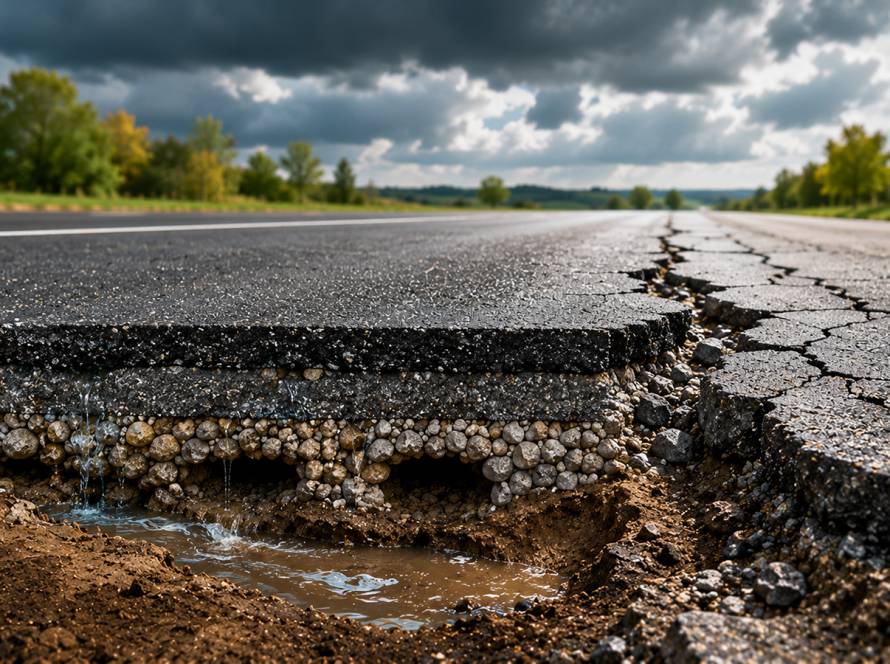
Water is one of the greatest threats to any road surface. Even high-quality surfacing materials can deteriorate rapidly if moisture is allowed to penetrate the construction.
Effective drainage begins during the design stage. Engineers calculate gradients that encourage surface water to flow away efficiently without creating standing water or erosion.
Beneath the surface, drainage systems help prevent groundwater from becoming trapped within the road structure. If water accumulates inside the pavement, repeated freeze-thaw cycles can weaken the supporting layers and eventually lead to cracking and pothole formation.
Well-designed drainage protects every structural component, significantly extending the working life of the road while reducing maintenance requirements.
Choosing Materials That Match Expected Traffic
Not every road experiences the same type of traffic. A lightly used private access road requires different engineering considerations from an industrial estate serving heavy goods vehicles every day.
Professional road design considers expected traffic volumes, axle loads and turning movements before selecting materials and pavement thicknesses.
Areas exposed to frequent braking, acceleration or tight turning often require stronger construction because these actions generate additional stresses within the surface. Similarly, loading bays and commercial entrances frequently demand greater structural capacity than standard carriageways.
Selecting the appropriate construction for anticipated use helps ensure the road performs consistently throughout its intended lifespan.
Readers planning commercial projects can learn more about professional commercial road surfacing solutions that are designed around expected traffic demands.
Precision During Installation
Even the best design can fail if installation standards are poor.
Modern surfacing relies on precise temperature control, accurate laying techniques and consistent compaction. Asphalt that cools too quickly may not bond correctly, while inadequate rolling can leave voids that later allow water ingress.
Experienced contractors coordinate equipment, material deliveries and weather conditions carefully to achieve consistent results across the entire project.
Machine-laid surfacing also improves uniformity by maintaining accurate levels and producing a smoother finish that distributes traffic loads more evenly.
High-quality machine lay tarmac installation helps ensure each section of the road performs consistently for many years.
Edge Support Is Easy to Overlook
Many people focus only on the centre of the road, but the edges are often where deterioration begins.
Without adequate edge restraint, repeated vehicle loading can gradually push the pavement sideways. This movement allows cracks to develop, which then permit water to penetrate the underlying structure.
Proper kerbing, edging systems and shoulder construction provide lateral support that keeps the pavement stable throughout its service life.
Although these details may appear minor, they contribute significantly to the overall durability of the finished road.
Regular Maintenance Preserves Structural Integrity
Even roads engineered to last twenty years benefit from periodic inspection and preventative maintenance.
Small cracks can often be sealed before they allow water into the pavement structure. Surface cleaning prevents drainage channels from becoming blocked, while isolated repairs stop localised defects from spreading into larger structural problems.
Addressing minor issues promptly is considerably more cost-effective than waiting until extensive reconstruction becomes necessary.
Where damage has already occurred, professional pothole repairs can restore localised areas before wider deterioration develops.
Long-Term Value Comes From Engineering Rather Than Appearance
A newly surfaced road always looks impressive immediately after completion, but appearance alone says very little about how long it will remain in good condition.
Roads that achieve service lives of twenty years or more are rarely the result of chance. They succeed because every stage of construction has been carefully planned and professionally executed. Ground conditions are assessed correctly, drainage is incorporated into the design, structural layers are built to specification and surfacing materials are installed under controlled conditions.
These engineering decisions remain invisible once the project is complete, yet they continue working every day throughout the life of the road.
Choosing experienced contractors who understand the complete construction process helps ensure the finished surface delivers reliable performance, lower maintenance costs and better long-term value for property owners, businesses and developers alike.
For projects requiring durable surfacing solutions, professional tarmac installation combines quality materials with proven construction techniques to maximise road lifespan.