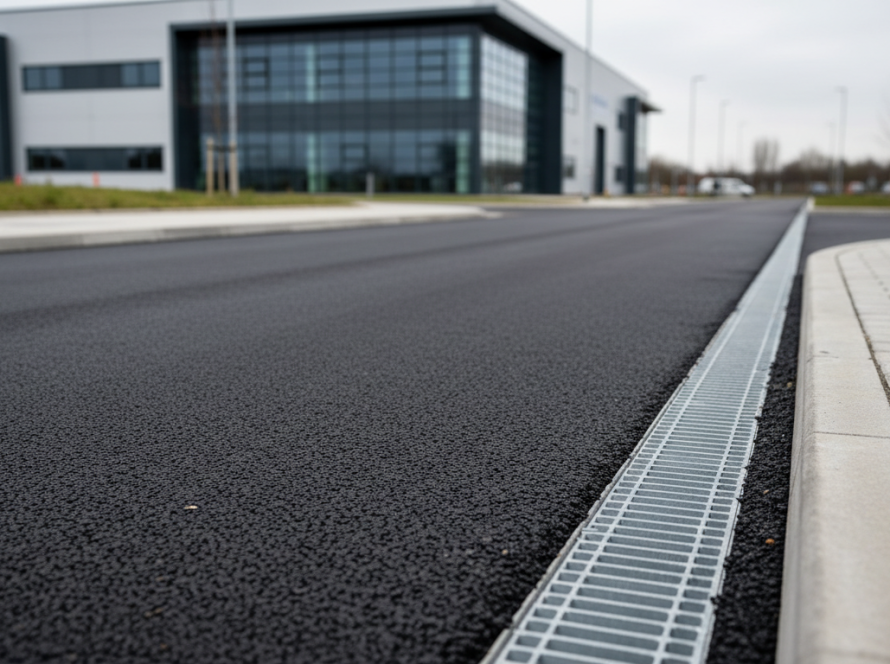
The condition of a business site begins influencing visitors before they reach the building. Access roads, car parks, loading areas and service yards all contribute to the first impression created by a commercial property. When these surfaces are uneven, cracked or affected by standing water, they can make an otherwise well-maintained site appear neglected.
For many UK businesses, tarmac is becoming the preferred surface for these important external areas. It provides a practical combination of durability, appearance, installation efficiency and manageable maintenance. It is suitable for a wide variety of commercial environments, including offices, industrial estates, retail parks, warehouses, schools, healthcare facilities and residential developments.
Commercial tarmac surfacing UK projects can also be adapted to suit different levels of traffic. A lightly used office entrance does not require exactly the same construction as a service yard used by delivery vehicles throughout the day. By adjusting the ground preparation, sub-base depth and surface specification, contractors can create a surface that reflects the demands of the site.
What Makes Tarmac Suitable for Commercial Properties?
Tarmac has been used throughout the UK for many years, but modern installation methods and machinery have made it particularly effective for business premises. It can be laid across large areas with a consistent finish, allowing contractors to create smooth routes for vehicles and pedestrians.
A properly constructed tarmac surface is designed to withstand regular use while maintaining a clean and professional appearance. It can cope with changing weather conditions and is suitable for the temperature variations experienced throughout the UK.
Professional commercial road surfacing also allows different sections of a site to be designed according to their purpose. The main entrance can be finished to create a strong visual impression, while loading bays and service roads can be constructed to tolerate greater weight and more frequent vehicle movements.
A Strong Surface for Regular Traffic
Commercial surfaces must often support a mixture of cars, vans, delivery vehicles and heavy goods vehicles. These loads place pressure on both the visible surface and the supporting layers beneath it.
Tarmac distributes vehicle loads across the pavement structure when it has been installed over a correctly prepared foundation. This helps reduce localised movement and limits the risk of premature deformation. The strength of the finished area depends on the entire construction, rather than the surface course alone.
The thickness of the sub-base and tarmac layers should therefore be selected according to expected traffic. A surface designed only for passenger vehicles may not perform adequately if articulated lorries begin using it regularly. Assessing present and future vehicle use allows the installation to be specified more accurately.
A Neat and Professional Appearance
Businesses need outdoor areas that look organised and well maintained. A smooth, dark tarmac finish can improve the appearance of an ageing commercial property and help define how vehicles should move around the site.
Line markings, pedestrian routes, parking bays and directional symbols can be applied clearly to a consistent tarmac surface. This is particularly important on sites where drivers need to understand the layout quickly.
The appearance of tarmac can also complement a wide range of building styles. It works well around modern offices, industrial units, retail premises and older commercial buildings without competing visually with the surrounding architecture.
Efficient Installation for Active Business Sites
Disruption is one of the main concerns for organisations planning surfacing work. Closing an entrance, car park or delivery area can affect staff, customers, suppliers and daily operations.
Tarmac can often be installed efficiently when the project has been planned around the needs of the business. Contractors may divide the site into phases, retain temporary access routes or schedule certain operations during quieter periods.
Large areas can be completed using machine-laid tarmac, which helps produce a consistent depth and finish. Machine laying can also improve productivity on suitable sites, reducing the time required to place and compact the material.
Installation speed should not come at the expense of preparation. The existing surface, ground conditions and drainage arrangements must still be assessed before work begins. Efficient installation depends on careful planning rather than simply laying the material as quickly as possible.
The Importance of Proper Ground Preparation
The long-term performance of any commercial surface is strongly influenced by what lies underneath it. Even high-quality tarmac can crack, sink or become uneven when it is installed over weak or poorly compacted ground.
Preparation may involve excavating unsuitable material, correcting levels and constructing a stable sub-base. Each layer must be compacted correctly so that it provides uniform support across the completed area.
Soft spots require particular attention. If they are covered without treatment, they may continue to move under traffic and eventually cause visible failure at the surface. Removing unstable material and replacing it with suitable compacted aggregate helps prevent this problem.
Professional tarmac installation and road surfacing should therefore begin with an assessment of the full pavement structure. The visible finish is important, but the foundation determines whether the surface can retain that finish under regular use.
Drainage and Surface Water Management
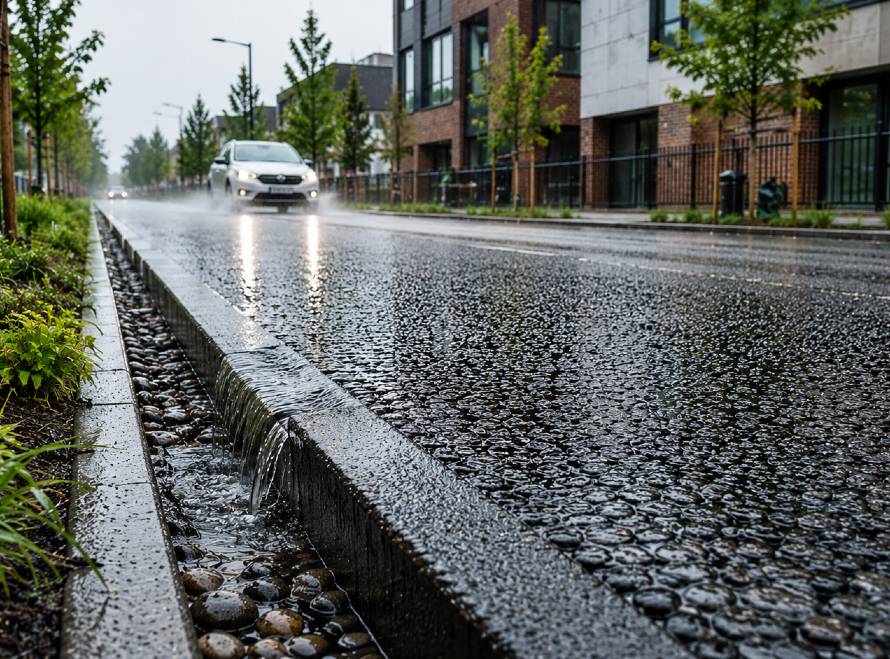
Rainfall is a constant consideration for outdoor commercial areas in the UK. Water that remains on the surface can create inconvenience, increase slip risks and gradually weaken vulnerable sections of the construction.
A commercial tarmac area should be laid with appropriate falls so that water moves towards drainage channels, gullies or other approved outlets. The required gradient must be created during the preparation stages because it cannot be corrected effectively by relying on the final surface layer alone.
Drainage design is especially important across large car parks and service yards. Water may travel across a considerable area before reaching an outlet, so levels must be coordinated carefully.
Existing drainage systems should also be inspected before resurfacing. Blocked, damaged or incorrectly positioned channels may need attention as part of the wider project. Simply laying new tarmac around a drainage problem is unlikely to provide a lasting solution.
A Practical Choice for Different Commercial Areas
One reason tarmac is becoming a first choice for UK businesses is its versatility. The same general surfacing material can be adapted for several areas within a commercial site.
Access roads require a smooth, durable finish that supports predictable vehicle movement. Car parks need clearly defined bays and safe pedestrian connections. Loading areas must tolerate stationary loads, turning forces and repeated braking. Service yards may also be exposed to skips, pallets, mechanical handling equipment and delivery vehicles.
The construction specification can be adjusted to suit these demands. Stronger supporting layers may be required in areas used by heavy vehicles, while additional attention may be given to joints and edges where vehicles turn frequently.
This flexibility allows businesses to create a consistent appearance across the property while still responding to the practical requirements of individual zones.
Maintenance and Whole-Life Value
The initial cost of a commercial surface is only one part of the decision. Businesses also need to consider how the area will perform over time and what maintenance it may require.
Tarmac is relatively straightforward to inspect. Early signs of wear, such as small cracks, surface fretting or localised depressions, can often be identified before they develop into more serious defects.
Prompt maintenance is important because water can enter damaged areas and affect the layers beneath the surface. Minor defects that are left untreated may expand under traffic and changing weather conditions.
Localised pothole repairs can restore damaged sections when the surrounding construction remains serviceable. More extensive deterioration may require resurfacing or reconstruction, depending on whether the problem is limited to the upper layer or extends into the foundation.
A planned inspection and maintenance programme helps businesses protect their investment. It also allows work to be scheduled before defects become disruptive or create avoidable safety concerns.
Improving Safety and Site Management
A smooth commercial surface contributes to safer and more efficient site movement. Uneven areas can affect drivers, cyclists and pedestrians, particularly in locations where different users share the same space.
Tarmac creates a suitable base for line markings and traffic management features. Parking bays, pedestrian crossings, loading restrictions and directional arrows can be displayed clearly, helping visitors understand how to navigate the premises.
Good surface levels also reduce unexpected changes in height that may create trip hazards. Around entrances, footways and crossing points, careful detailing can improve accessibility for people using wheelchairs, mobility aids or pushchairs.
Safety still depends on the overall site design. Lighting, signage, visibility and traffic controls must work alongside the surfacing. However, a consistent surface provides the stable foundation needed for these measures to function effectively.
When Resurfacing May Be More Appropriate Than Replacement
Not every worn commercial surface requires complete excavation. Where the underlying structure remains stable, it may be possible to remove or prepare the damaged upper layer and install a new tarmac course.
Resurfacing can improve appearance, restore grip and correct minor surface defects. It may also reduce project duration compared with full reconstruction.
However, an overlay should not be used to conceal structural failure. Deep depressions, widespread cracking and repeated potholes may indicate movement within the sub-base. Covering these symptoms without addressing their cause can result in the defects returning through the new surface.
A professional site assessment helps determine whether resurfacing, local repair or complete reconstruction is the most suitable approach. Examples of completed surfacing projects can also help property managers understand how different treatments are applied across commercial environments.
Why Specification Matters More Than Material Alone
Choosing tarmac does not automatically guarantee a durable result. Its performance depends on the specification, preparation, installation conditions and quality control applied throughout the project.
The contractor should consider vehicle types, traffic frequency, drainage, existing ground conditions and the intended lifespan of the area. The surface must then be laid at the correct temperature, compacted effectively and finished with properly constructed edges and joints.
Commercial tarmac surfacing UK installations should be designed around the actual site rather than based on a standard approach. A warehouse yard, office car park and private business road may all use tarmac, but each requires a different assessment.
When these details are handled correctly, tarmac provides a strong balance of practicality and appearance. It creates a surface that can support everyday business activity without demanding excessive maintenance or complicated care.
A Reliable Surface for Modern UK Businesses
Businesses are increasingly looking for external surfaces that support operations, improve presentation and provide dependable long-term performance. Tarmac meets these requirements across a wide range of commercial settings.
Its smooth finish helps create orderly access routes and clearly marked parking areas. Its construction can be strengthened for delivery traffic and loading operations. Its installation can also be planned in phases to reduce disruption on active premises.
The most successful projects begin with careful preparation and a specification based on real site conditions. Drainage, traffic loading, sub-base quality and future maintenance all need to be considered before the surface is laid.
For UK businesses managing busy outdoor areas, professionally installed tarmac offers a practical and adaptable solution. It is this combination of durability, efficiency and professional appearance that is making it an increasingly common first choice for commercial properties.