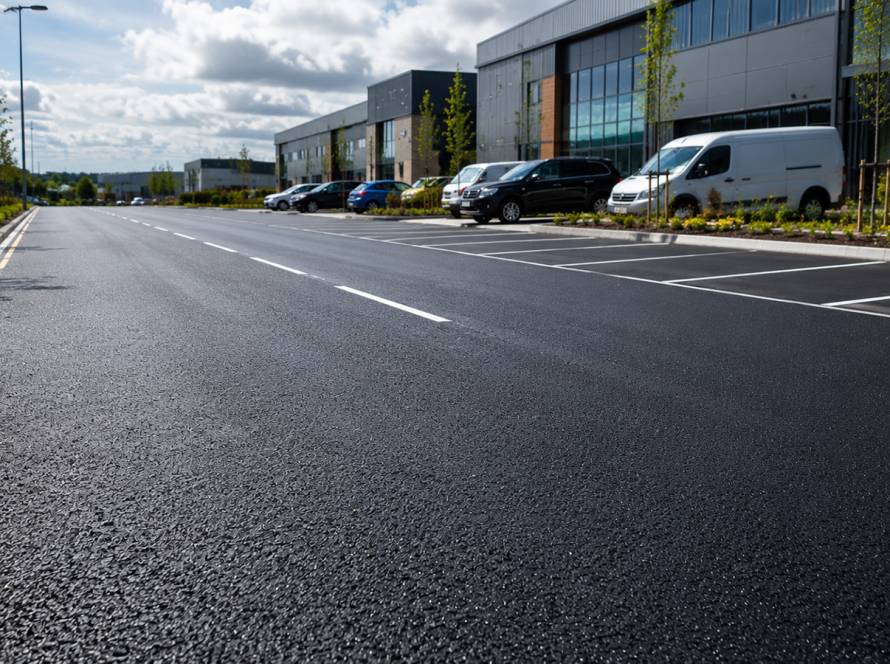
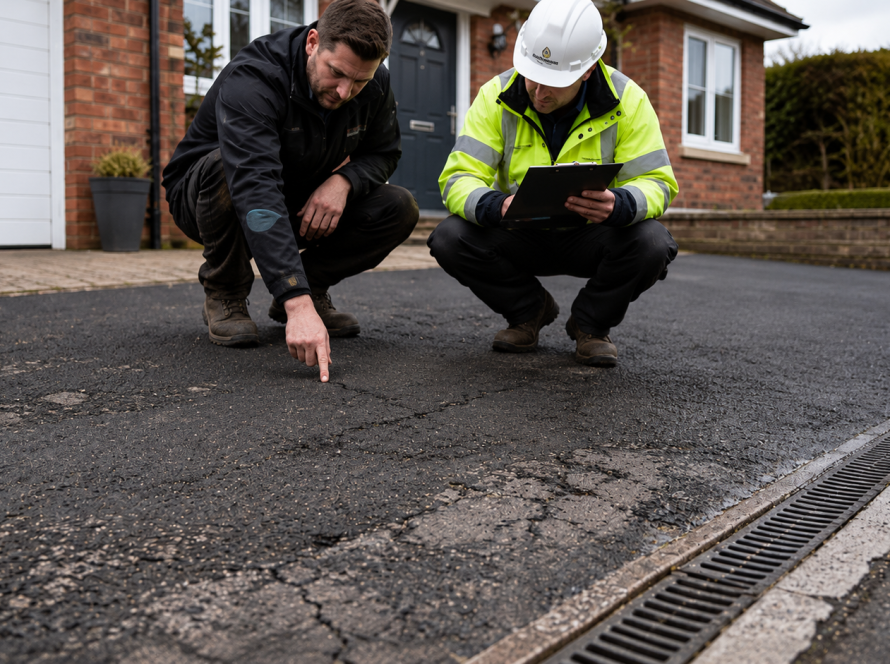
Heavy rain is a familiar part of British weather, but repeated periods of intense rainfall can create significant problems for roads, access routes, car parks and other surfaced areas. The damage is not always immediately visible. Water can gradually penetrate weaknesses in a surface, affect the supporting layers underneath and turn relatively minor defects into much more substantial failures.
Understanding the road surfacing rain impact UK property owners and site managers face is particularly important when maintaining commercial access roads and heavily used private surfaces. A road may appear reasonably sound during dry weather while already containing cracks, weakened joints or drainage problems that allow water to enter its construction.
Once water begins reaching the layers beneath the finished surface, deterioration can accelerate. This is why effective drainage, suitable preparation and correctly installed surfacing all play important roles in the long-term performance of a road.
Professional commercial road surfacing therefore needs to consider more than the visible wearing course. The condition of the underlying construction and the way water is managed across the entire site can be just as important.
How Water Gets Beneath a Road Surface
A properly constructed road surface is designed to cope with normal exposure to the weather, but no surface remains completely unaffected indefinitely. Traffic, temperature changes and general ageing can eventually create small openings through which water can penetrate.
Hairline cracks are one common entry point. They may initially appear insignificant, particularly on a large commercial road or access route. During prolonged rainfall, however, water can repeatedly enter these cracks and reach lower layers of the construction.
Edges are another vulnerable area. Where a surfaced road meets verges, kerbs, drainage features or other materials, weaknesses can develop if the edge is not adequately supported or maintained. Water travelling along these boundaries may begin affecting the road from the side rather than directly through its upper surface.
Previous repairs can also become vulnerable if joints deteriorate. A repaired section may remain serviceable for a considerable period, but damaged edges around the repair can eventually allow water to penetrate.
The important point is that visible standing water is not the only concern. A surface can drain reasonably quickly while still allowing moisture to reach areas where it can cause structural deterioration.
What Happens When the Sub-Base Becomes Saturated
The visible tarmac or asphalt layer is only one part of a road construction. Beneath it sits a supporting structure designed to distribute vehicle loads and provide a stable foundation.
When excessive water reaches these underlying materials, their ability to provide consistent support can be affected. The severity depends on the construction of the road, the materials used, the condition of the drainage and the volume of water involved.
A weakened foundation means the surface above may begin moving more than intended under traffic. Over time, this can contribute to depressions, cracking and localised failures.
Heavy vehicles make the problem more significant because they place substantial loads on areas where the underlying support may already have been compromised. Commercial entrances, industrial estates, loading areas and access roads used by delivery vehicles can therefore require particular attention after prolonged periods of wet weather.
Quality tarmac installation and road surfacing depends on establishing suitable foundations before the finished layers are installed. If the supporting construction is unsuitable or becomes badly compromised by water, simply addressing the visible surface may not resolve the underlying cause.
Why Poor Drainage Accelerates Road Deterioration
Drainage is one of the most important factors affecting how a road performs during heavy rainfall. Water needs a clear route away from the surface rather than being allowed to remain in depressions or repeatedly flow towards vulnerable areas.
A road should normally be constructed with appropriate falls so that water moves towards drainage points or suitable discharge areas. Problems arise when those falls are insufficient, when the surface becomes deformed or when drainage channels and gullies cannot handle the water reaching them.
Standing water increases the amount of time moisture remains in contact with the surface. Existing cracks and joints are consequently exposed for longer periods, increasing opportunities for water penetration.
Blocked drainage can make the situation worse. Leaves, silt, mud and other debris may restrict gullies and channels, particularly during autumn and winter. During intense rainfall, drainage that works adequately under normal conditions may become overwhelmed.
For property owners and commercial site managers, persistent puddles should therefore be treated as useful warning signs rather than simply an inconvenience. They can indicate that the surface profile or drainage arrangement requires investigation.
How Heavy Rain Contributes to Pothole Formation
Potholes rarely appear without an underlying reason. They commonly develop after the road structure has already started weakening.
Water entering a crack or damaged area can affect the material beneath the surface. Traffic then repeatedly passes over the weakened section, placing pressure on an area that no longer has uniform support. The surface can begin breaking apart, allowing additional water to enter and accelerating the cycle.
Once loose material starts being displaced, the defect can expand surprisingly quickly, particularly on frequently used routes.
This helps explain why periods of wet weather can appear to produce a sudden increase in potholes. The rainfall may not have created every weakness from the beginning, but it can expose and accelerate deterioration that was already developing.
Prompt pothole repairs can prevent a relatively contained defect from becoming a larger problem, although the cause of repeated failures should also be considered. If water continues reaching the same location because of poor drainage or deeper structural weakness, repairing only the surface may provide limited long-term benefit.
Why Commercial Roads Are Particularly Vulnerable
Commercial roads often operate under more demanding conditions than lightly used residential surfaces. Delivery vehicles, refuse vehicles, plant machinery and regular staff or customer traffic can place repeated loads on the pavement construction.
Heavy rain can combine with these loads to accelerate existing weaknesses. An area that performs adequately when its supporting layers are stable may respond differently once excessive moisture has entered the construction.
Turning areas are especially demanding because vehicle tyres place lateral forces on the surface. Loading bays, entrances and junctions can also experience concentrated wear because vehicles repeatedly follow similar paths.
For these environments, the road should be considered as part of the site’s working infrastructure. Deterioration can affect vehicle movement, pedestrian safety and access to operational areas.
Regular inspection is therefore valuable, particularly following prolonged or unusually intense rainfall. Identifying changes in the surface early gives site managers more opportunity to investigate before deterioration spreads across a wider area.
Heavy Rain Can Expose Existing Construction Problems
Not every road damaged during wet weather has failed because of rainfall alone. In many cases, rain reveals weaknesses that already existed.
Insufficient preparation, unsuitable sub-base materials, poor compaction or inadequate drainage can remain relatively unnoticed for a period. Once substantial volumes of water reach the construction, those weaknesses may become more apparent.
Depressions can begin holding water. Edges may move or break away. Previously minor cracks can become wider, while sections subjected to heavy vehicles may start deforming.
This is why diagnosing road failure requires more than looking at the upper surface. The location and pattern of the damage can provide important clues about what is happening underneath.
Where larger areas have deteriorated, professional machine-laid tarmac can provide a consistent finish as part of appropriately planned resurfacing work. However, the supporting structure and drainage still need to be suitable before a new surface is installed.
Why Resurfacing Over a Wet Problem Is Not Enough
When a road begins looking worn, resurfacing can appear to be the obvious answer. In suitable circumstances, renewing the surface is an effective way to restore performance and appearance. It should not, however, be used to conceal unresolved structural or drainage problems.
If water is entering because of defective drainage, simply placing new material over the affected area does not necessarily eliminate the cause. Similarly, if the underlying layers have lost stability, additional surface material cannot automatically restore the required support.
The existing construction needs to be assessed so that the appropriate repair depth can be determined. Some areas may require localised repairs, while more extensive deterioration can require deeper reconstruction before resurfacing takes place.
This assessment is particularly important on commercial sites where closing the road again shortly after completion would create unnecessary disruption.
The Importance of Timing Surfacing Work Around Rainfall
Rain does not only affect existing roads. It also influences how resurfacing and repair projects should be planned.
Surface preparation needs to provide suitable conditions for the materials and methods being used. Excessive water on the working area can interfere with preparation and may make certain operations unsuitable until conditions improve.
This makes weather monitoring an important part of road surfacing project management. Experienced contractors need to consider current conditions, forecast rainfall and the state of the prepared surface rather than treating the programme as completely independent of the weather.
Postponing part of a project because conditions are unsuitable can be preferable to proceeding when the quality of the finished construction could be compromised.
The road surfacing rain impact UK projects experience is therefore relevant both before and after installation. Managing weather conditions during construction is one part of delivering a surface capable of performing reliably afterwards.
Signs That Rain Is Already Affecting Your Road
Property owners and site managers do not need to wait for major potholes before paying attention to wet-weather performance. Changes in how water behaves across a surface can provide early indications of a developing problem.
Persistent puddles in areas that previously drained effectively may indicate settlement or deformation. Cracks that remain visibly wet after the surrounding surface has dried can suggest that water is entering or being retained within them. Loose aggregate, broken edges and small areas of surface movement can also justify closer inspection.
Mud or fine material appearing around damaged sections may indicate movement beneath the visible surface. Repeated failure in exactly the same location can be particularly important because it may point towards a deeper problem rather than an isolated surface defect.
Reviewing these areas during or shortly after rainfall can sometimes reveal drainage issues that are much harder to identify during dry conditions.
Protecting Road Surfaces Against Future Wet Weather
There is no practical way to prevent British roads from being exposed to rain, so effective road construction focuses on managing water rather than attempting to avoid it.
Good preparation provides stable support. Appropriate compaction helps create a consistent construction. Suitable surface levels direct rainfall towards drainage points, while properly designed drainage helps remove water efficiently from the road.
Maintenance then becomes essential as the road ages. Cracks, damaged edges and drainage blockages should not automatically be treated as cosmetic issues. They can create pathways through which water reaches vulnerable parts of the construction.
Site managers planning upgrades can review the wider range of road surfacing services available to determine whether deterioration requires targeted repairs, resurfacing or more extensive reconstruction.
Total Surfacing Internal Links.pdf
Managing the Long-Term Effects of Heavy Rain
Heavy rainfall becomes particularly damaging when water, structural weakness and repeated traffic loads occur together. A well-constructed road with effective drainage is better positioned to cope with wet conditions than a surface already affected by cracking, poor falls or inadequate support.
The key is to consider the road as a complete construction rather than focusing exclusively on the visible top layer. Drainage, foundations, compaction, surface condition and traffic loading all influence how successfully the road deals with prolonged rainfall.
For commercial property owners and site managers, inspecting roads after significant wet weather can help identify developing defects before they become more disruptive. Persistent standing water, expanding cracks, depressions and recurring potholes are all reasons to investigate what is happening beneath the surface.
Heavy rain is unavoidable across the UK, but rapid deterioration does not have to be accepted as inevitable. Correct construction, effective drainage and timely maintenance provide the strongest basis for keeping surfaced roads stable, safe and serviceable through repeated periods of challenging British weather.