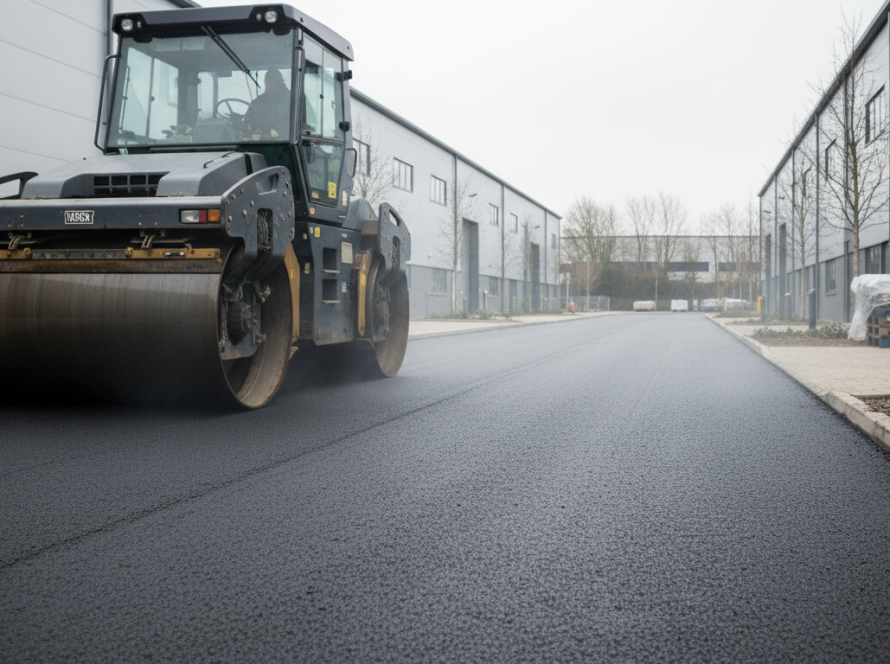
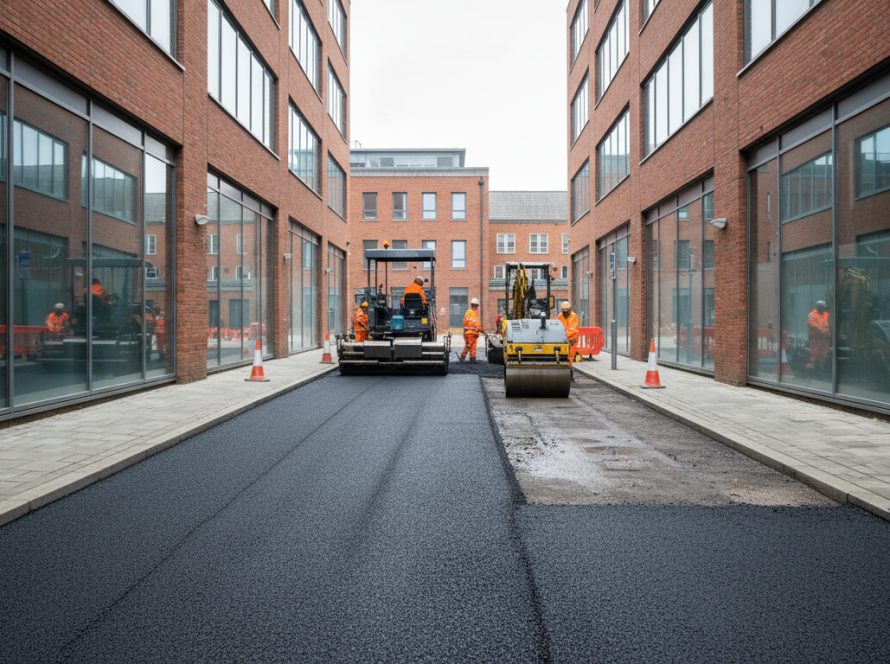
When a road, access route or hardstanding begins to deteriorate, the first visible signs often appear around the edges. Small cracks develop, sections begin to crumble and the outer surface can gradually lose its original shape. Although these problems may initially look minor, edge deterioration can spread towards the centre of the road and eventually affect a much larger area.
The reason is relatively straightforward. The middle of a surfaced road is normally surrounded by compacted material and receives support from both sides. At the edge, that continuous lateral support ends. This makes the outer section more vulnerable to movement when vehicles pass over it, particularly where wheels regularly travel close to the boundary.
Proper road surfacing edge restraints UK contractors install are therefore an important part of the overall construction. They help keep the pavement structure contained, reducing sideways movement and protecting the vulnerable transition between the surfaced area and the surrounding ground.
How Traffic Loads Affect Road Edges
Every vehicle passing over a road transfers weight through the surface and into the supporting layers underneath. A properly constructed road distributes these forces across its structure rather than allowing them to concentrate in one small area.
Problems can arise when vehicles repeatedly travel close to an unsupported edge. The material has less resistance to sideways movement, so repeated loading can gradually cause deformation. Heavy commercial vehicles can make this process more noticeable because their axle loads place greater stress on the pavement structure.
Turning movements can create additional pressure. Instead of travelling in a straight line, tyres generate lateral forces against the surface. This is particularly relevant around entrances, junctions, loading areas and narrow access roads where drivers frequently manoeuvre close to the outer boundary.
For sites expected to handle regular commercial traffic, correctly designed commercial road surfacing needs to consider these loading patterns rather than treating the road edge as an insignificant part of the installation.
The Importance of Proper Edge Restraints
An edge restraint provides physical support along the boundary of a surfaced area. Depending on the design of the site, this may involve kerbs, concrete edging or another suitable construction detail capable of resisting movement.
The objective is not simply to produce a neat visual boundary. The restraint performs a structural function by helping prevent the pavement materials from spreading sideways under traffic loads.
Without sufficient restraint, movement may occur gradually. The surface can initially look acceptable after installation, but repeated vehicle loading can begin pushing material towards the unsupported side. Once movement starts, cracking and surface deterioration can follow.
Effective road surfacing edge restraints UK installations should therefore be considered during the design and preparation stages rather than added as an afterthought once the main surfacing has been completed.
Why Poor Ground Support Causes Edge Failure
The visible surface is only one part of a road construction. Beneath the asphalt or tarmac are supporting layers that provide stability and distribute vehicle loads into the ground.
If the sub-base becomes weak or poorly compacted near the boundary, the surface above it can lose support. This may result in settlement, cracking or deformation along the edge.
Problems are particularly likely where the ground immediately beside the road is soft or unstable. A vehicle wheel travelling close to the boundary can place part of its load over an area with reduced support. Over time, the repeated loading may cause the edge to sink or break away.
Good preparation should therefore extend across the entire construction width. Concentrating attention only on the central running area can leave vulnerable outer sections that undermine the durability of the finished road.
Professional tarmac installation and road surfacing should account for preparation, compaction and edge stability as connected parts of the same construction process.
Water Can Accelerate Edge Deterioration
Water is another common factor in road edge problems. The boundary between a surfaced road and the surrounding ground can create an easy route for water to enter the pavement structure if drainage and construction details are inadequate.
Once moisture reaches the supporting layers, their ability to carry traffic loads may be reduced. Movement can then develop beneath the surface, eventually appearing as cracking or deformation.
Water can also wash fine material away from unsupported edges. This gradually reduces support and creates voids beneath the outer part of the surface. The pavement may then begin breaking away when vehicles travel across the weakened area.
Drainage should therefore be considered as part of the road design rather than simply as a way of preventing visible puddles. Controlling where water flows and preventing unnecessary infiltration can make a substantial difference to long-term surface performance.
Why Small Edge Cracks Should Not Be Ignored
A narrow crack near the side of a road may not immediately affect vehicle access, which means it can easily be overlooked. However, cracks provide another route for moisture to enter the pavement structure.
Traffic and weather can gradually enlarge the opening. Once the surrounding material loses support, small fragments may begin breaking away. The damaged section can then expand further into the road.
Early intervention is generally more straightforward because the deterioration remains localised. Where appropriate, professional pothole repairs and localised surface repairs can address damaged areas before they develop into more extensive defects.
The underlying cause still needs to be considered. Simply filling a damaged edge without correcting poor support, drainage or restraint may leave the same weakness in place.
Compaction Matters at the Boundary
Achieving consistent compaction across a road is essential for producing a stable surface. However, edges can sometimes be more difficult to compact effectively than central areas, particularly where access for machinery is restricted.
Insufficient compaction can leave material more susceptible to movement under traffic. Small amounts of deformation may eventually create cracks, depressions or crumbling.
The challenge becomes greater on narrow roads, irregularly shaped sites and locations containing walls, fences or existing structures. Contractors need to select suitable equipment and working methods so that the outer sections receive appropriate attention.
Where site conditions permit, machine lay tarmac can help achieve a controlled and consistent installation. The exact method should always reflect the dimensions, access limitations and intended use of the site.
Vehicle Overrunning Can Damage Otherwise Sound Edges
Not every edge failure is caused by poor installation. Sometimes the road has been constructed appropriately but is being used differently from the way originally intended.
Large vehicles may regularly place wheels beyond the surfaced width when passing, turning or entering a site. The verge beside the road can become compressed, creating a height difference between the surface and the surrounding ground.
When vehicles subsequently return onto the road, tyres can strike the exposed edge. Repeated impacts may gradually break material away.
This is common on narrow access roads where there is limited room for two vehicles to pass. Commercial sites can experience similar problems around gateways and loading areas where delivery vehicles require wider turning movements.
Understanding actual traffic behaviour is therefore important when deciding the required road width and edge construction.
Why Previous Repairs Can Fail at Their Perimeter
Repairs themselves have edges, and these boundaries can become vulnerable if the repair has not been properly integrated with the existing pavement.
A patch may contain strong new material, but its performance also depends on the condition of the surrounding road. If the existing pavement is cracked, unstable or poorly supported, deterioration can continue around the repair.
Water penetration at the joint between old and new materials can create further problems. Traffic then repeatedly loads the boundary, gradually exposing weaknesses in the surrounding pavement.
This is why successful road repair involves more than covering the visible damaged area. The condition around the defect needs to be assessed so the repair reaches stable material and provides suitable support.
Edge Damage Can Indicate Wider Structural Problems
Although deterioration may begin at the boundary, it should not automatically be treated as a purely cosmetic edge problem. In some situations, the damage can indicate weaknesses elsewhere in the pavement structure.
Long cracks running parallel with the road edge may suggest inadequate support. Settlement can indicate sub-base or ground movement. Repeated failures after previous repairs may point towards drainage problems or construction weaknesses that have not been addressed.
A proper assessment should consider the pattern of deterioration, surrounding ground conditions, traffic type and drainage behaviour.
This broader approach helps determine whether a local repair is appropriate or whether more extensive resurfacing work should be considered.
Designing Road Edges for Long-Term Performance
Reliable road construction depends on treating the edge as part of the pavement structure rather than simply the point where the surfacing finishes.
Suitable ground preparation provides a stable foundation. Correct compaction reduces unwanted movement. Appropriate restraints help contain the pavement materials, while effective drainage limits the amount of water reaching vulnerable supporting layers.
The expected traffic also needs to be considered. A lightly used private access road will experience different loading from a commercial estate regularly used by heavy goods vehicles. Road width, construction depth and edge details should reflect these conditions.
Well-planned road surfacing services consider the complete site rather than focusing only on the visible wearing course. This is particularly important where existing edge damage has already demonstrated how traffic moves through the area.
Preventing Edge Failure Through Good Construction
Many road edge problems develop gradually. A small amount of movement leads to cracking, water enters the structure and repeated traffic loading causes the weakened area to deteriorate further. What begins as a narrow damaged strip can eventually become a significant maintenance issue.
Proper road surfacing edge restraints UK installations help interrupt this process by providing support where the pavement is naturally most exposed. Their effectiveness is strongest when combined with suitable sub-base construction, thorough compaction, effective drainage and a road layout designed for the vehicles actually using the site.
Property owners and commercial site managers should therefore pay attention to early signs such as parallel cracking, crumbling, settlement or exposed edges. These defects can provide useful evidence about what is happening beneath the surface.
Addressing the cause of deterioration rather than repeatedly treating the visible damage provides a stronger basis for durable repairs. When the supporting structure, drainage and edge restraint all work together, the finished road is better equipped to withstand regular traffic and changing British weather conditions.