It is common to see a road surface remain in reasonable condition for years while the section around a bus stop develops cracks, rutting, depressions, and potholes much earlier. Across the UK, local authorities, commercial estates, transport operators, and private road owners regularly face this issue.
The reason is simple: bus stops create a concentration of stresses that are rarely found elsewhere on a road. While traffic moves continuously along most streets, buses repeatedly slow down, stop, remain stationary under significant weight, and then accelerate away. This combination of forces places exceptional pressure on the road structure.
As a result, bus stop road failure UK problems often appear long before deterioration becomes visible on the rest of the carriageway.
The Impact of Heavy Static Loads
A moving vehicle distributes its load differently from a stationary one. When a bus comes to a halt, the weight remains concentrated in a relatively small area for a prolonged period.
Modern buses can weigh many tonnes, particularly when carrying passengers during peak travel periods. Every day, this weight is repeatedly applied to exactly the same location.
Over time, the pressure compresses the surface and underlying layers. If the road was not designed to withstand these concentrated loads, the surface begins to deform. Small depressions may form initially, but repeated loading eventually leads to rutting, cracking, and structural weakness.
This process is accelerated when multiple bus services use the same stop throughout the day.
Braking Forces Create Additional Stress
Weight alone is not responsible for premature deterioration. The braking action that occurs as a bus approaches a stop creates substantial horizontal forces.
Unlike general traffic moving at a consistent speed, buses apply repeated braking pressure at the same point every day. This generates shear stress within the surfacing layers.
When surfacing materials are unable to resist these forces, the surface begins to move slightly under load. Although this movement may be invisible at first, repeated cycles eventually weaken the bond between materials and contribute to cracking.
Road sections approaching bus stops often show signs of wear before the actual stopping area because this is where the greatest braking forces occur.
Acceleration Damage After Passenger Boarding
Once passengers have boarded and the bus departs, a different type of stress is introduced.
Acceleration transfers weight and torque through the wheels, creating forces that pull and push against the road surface. These forces can gradually displace surfacing materials and weaken structural integrity.
Where road construction has been compromised by inadequate preparation, poor compaction, or insufficient layer thickness, the effects become even more noticeable.
The combined effect of braking, stationary loading, and acceleration means a bus stop experiences significantly more punishment than many other sections of road.
Why Traditional Surfacing Can Struggle
Not all road surfaces are designed for intensive bus traffic.
Standard surfacing solutions may perform adequately on residential streets or lightly trafficked access roads. However, areas subject to repeated heavy vehicle loading often require stronger construction methods and more durable materials.
Where the original road was designed for cars and light commercial vehicles, the arrival of frequent bus traffic can create loading conditions beyond the intended design capacity.
This is one reason many transport authorities specify reinforced surfacing systems, thicker asphalt layers, or specialist materials in bus stop locations.
Professional commercial road surfacing projects typically account for these loading requirements during the design stage to reduce long-term maintenance costs.
The Importance of Sub-Base Strength
Road performance is heavily influenced by what lies beneath the visible surface.
The sub-base acts as the foundation of the road structure. If this layer lacks sufficient strength, even the highest-quality surface materials may eventually fail.
At bus stops, repeated heavy loading can expose weaknesses within the foundation far more quickly than elsewhere on the street.
Signs of sub-base failure often include sinking areas, uneven surfaces, cracking patterns, and persistent depressions that reappear after repairs.
Where underlying support has been compromised, simply resurfacing the affected area may not provide a lasting solution. Structural reconstruction is often necessary to address the root cause.
Drainage Problems Can Accelerate Failure
Water remains one of the biggest threats to road longevity.
Bus stop locations frequently suffer from drainage issues because the surface profile changes over time. As rutting develops, water begins to collect in low spots instead of draining effectively.
Standing water increases the likelihood of surface deterioration. Moisture can penetrate small cracks and weaken underlying layers. During colder weather, freeze-thaw cycles may worsen existing damage and enlarge defects.
Proper drainage design is therefore essential when constructing or upgrading bus stop infrastructure.
Roads that incorporate effective water management systems generally achieve longer service lives and require fewer reactive repairs.
Repeated Traffic Channelisation
One of the unique characteristics of bus stops is the consistency of vehicle positioning.
Unlike general traffic, which spreads across different parts of a lane, buses tend to stop in virtually the same location every time. The wheels follow a predictable path, concentrating stress into narrow channels.
This phenomenon, known as traffic channelisation, creates localised wear patterns that are rarely distributed evenly across the road.
Over months and years, the repeated wheel loading gradually compresses and deforms the surface structure.
The result is often visible rutting that mirrors the exact wheel tracks used by buses.
Material Selection Matters
Choosing appropriate surfacing materials plays a significant role in preventing premature failure.
Conventional asphalt mixes may perform well under normal traffic conditions but can struggle under intense static and dynamic loading. For this reason, engineers often specify specialist materials for bus stop construction.
High-performance asphalt, polymer-modified binders, and reinforced surfacing systems can offer greater resistance to deformation. These materials are specifically designed to withstand the stresses associated with heavy public transport vehicles.
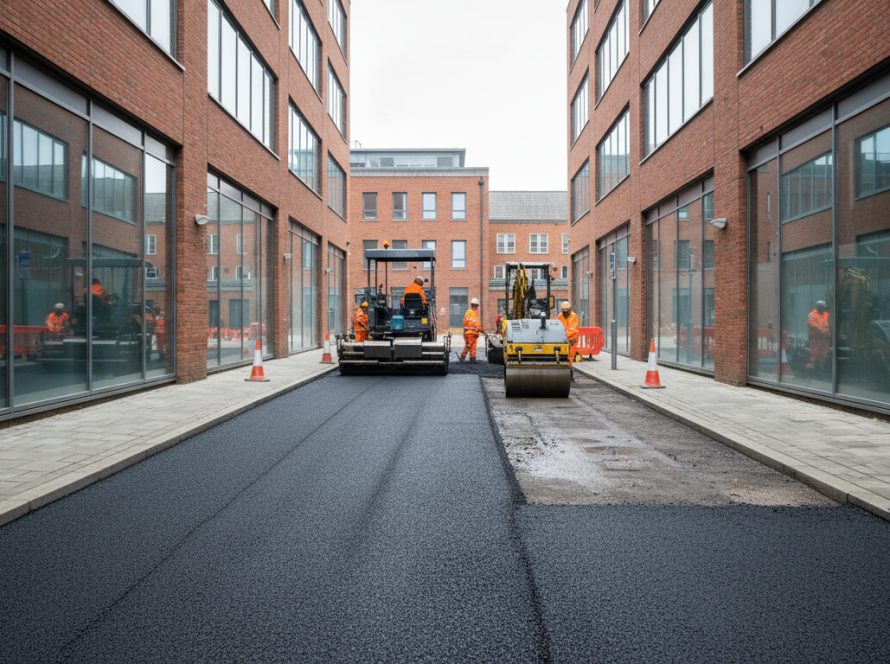
Quality tarmac installation also contributes to long-term performance by ensuring materials are laid and compacted correctly.
Even the best materials can underperform if installation standards are poor.
The Role of Compaction in Surface Longevity
Compaction is one of the most important stages of road construction.
A properly compacted surface contains fewer voids and provides greater structural strength. This allows the road to distribute loads more effectively throughout the pavement layers.
Insufficient compaction can leave weak points within the surface. Under bus traffic, these weaknesses often become apparent quickly.
Premature settlement, cracking, and surface deformation may occur within a relatively short period after construction if compaction standards are not achieved.
This is why experienced contractors frequently utilise specialist machine lay tarmac methods to achieve consistent results on demanding projects.
Why Repairs Often Fail Repeatedly
Many bus stop repairs appear successful initially but deteriorate again within a short period.
In many cases, the visible defect is only a symptom of deeper structural problems. If the repair addresses the surface without resolving weaknesses beneath it, the same loading forces will continue to cause damage.
A pothole may be filled successfully, but if the underlying pavement remains compromised, cracks and depressions are likely to return.
Long-term solutions often require detailed investigation, structural assessment, and reconstruction of affected layers rather than simple surface treatments.
Where defects have already developed, professional pothole repairs should form part of a wider maintenance strategy focused on the overall pavement structure.
Designing Roads Specifically for Bus Traffic
Modern road design increasingly recognises the unique demands placed on bus stop locations.
Engineers now assess traffic volumes, vehicle weights, stopping frequency, drainage requirements, and expected service life before determining construction specifications.
Rather than treating bus stops as ordinary sections of carriageway, many projects use enhanced pavement designs that provide additional structural support.
This proactive approach reduces maintenance requirements and improves long-term value for local authorities, transport operators, and commercial property owners.
By recognising bus stops as high-stress environments, designers can implement solutions that minimise future disruption and extend pavement lifespan.
Conclusion
Bus stop road failure UK issues occur because these locations are exposed to a unique combination of stresses that most roads never experience. Heavy static loads, repeated braking, acceleration forces, concentrated wheel tracking, drainage challenges, and structural weaknesses all contribute to accelerated deterioration.
While the surrounding street may remain in good condition, the bus stop area often acts as the most demanding section of the road network. Successful long-term performance depends on strong foundations, appropriate materials, effective drainage, quality installation, and construction methods specifically designed for heavy vehicle traffic.
When these factors are addressed during planning and construction, bus stop surfaces can achieve significantly greater durability and resist the premature failures that commonly affect poorly designed road infrastructure.