Block paving is a popular choice for driveways across the UK because it provides an attractive, practical and relatively easy-to-maintain surface. However, one problem that property owners sometimes experience is block paving sinking in the areas where vehicles are regularly parked.
These depressions often develop beneath the wheels of a car, creating visible dips in what was originally a level driveway. In some cases, the problem appears within months of installation, while on other driveways it develops gradually over several years.
Block paving sinking under car parking areas is usually associated with movement or inadequate support beneath the paving rather than a problem with the blocks themselves.
Understanding the causes of driveway settlement is important because simply lifting and repositioning the affected blocks may not provide a lasting solution. The underlying construction must be assessed to establish why the surface has moved.
The Most Common Cause Is Poor Sub-Base Preparation
The sub-base is one of the most important parts of any block paved driveway. It sits beneath the laying course and distributes vehicle loads into the ground below.
A properly constructed driveway relies on a stable foundation capable of supporting the weight of vehicles without excessive movement.
If the sub-base is too thin, inadequately compacted or constructed using unsuitable material, it may gradually settle under repeated loading.
This can result in depressions forming where vehicles are parked most frequently.
Why Sub-Base Compaction Matters
Compaction reduces voids between the particles of the sub-base material and improves its ability to support traffic loads.
When this process is not completed correctly, the material can continue consolidating after the driveway has been installed.
The weight of a parked vehicle, combined with repeated vehicle movements, may gradually compress the inadequately compacted material.
As the supporting layer settles, the block paving above follows the movement.
Professional tarmac installation and road surfacing also depends on correct foundation preparation. Although block paving and tarmac have different construction methods, both require stable supporting layers to achieve reliable long-term performance.
Why Sinking Often Appears Beneath Car Wheels
One of the most noticeable characteristics of driveway settlement is that depressions frequently develop in two parallel areas corresponding to the vehicle’s wheel positions.
This happens because vehicle loads are transferred into the driveway through relatively small tyre contact areas.
Although the total weight of a car is distributed between its wheels, the pressure applied to the surface is concentrated around those contact points.
When a vehicle is parked in the same position every day, the same sections of paving experience repeated loading.
If the foundation beneath these areas is weak, settlement may become more noticeable.
Does Leaving a Car Parked Cause Block Paving to Sink?
A correctly designed and installed block paved driveway should support the intended weight of ordinary domestic vehicles without developing significant depressions simply because a car remains parked.
However, repeated parking can expose weaknesses in the construction.
The problem becomes more likely when the sub-base has not been properly prepared, the ground beneath the driveway is unstable or the pavement was not designed for the vehicles using it.
Larger vehicles, including heavy vans and motorhomes, may place additional demands on a driveway originally intended for smaller passenger cars.
The important distinction is that parking a vehicle is not normally the underlying cause of settlement in a properly constructed driveway. It is often the loading that reveals an existing weakness.
Incorrect Laying Course Thickness Can Cause Settlement
Block paving is normally installed over a carefully prepared laying course, commonly consisting of suitable bedding aggregate.
This layer allows the paving blocks to be positioned at the correct level and provides uniform support.
However, the laying course should not be used to compensate for substantial irregularities in the underlying sub-base.
If excessive bedding material is placed beneath the blocks, it may settle or move under traffic.
This can create localised depressions, particularly where vehicle wheels repeatedly apply pressure.
Why a Consistent Laying Course Is Important
A consistent laying course helps distribute support evenly beneath the paving blocks.
If some sections contain substantially more bedding material than others, the driveway may respond unevenly to vehicle loading.
Over time, the deeper sections may experience greater movement, creating dips in the finished surface.
Correct installation therefore requires careful preparation and levelling of the sub-base before the laying course is placed.
The foundation should provide the main structural support rather than relying on the bedding layer to compensate for inadequate ground preparation.
Poor Drainage Can Weaken the Driveway Foundation
Water is another important factor in block paving settlement.
Driveways are exposed to regular rainfall, particularly during prolonged periods of wet British weather.
A properly designed driveway should manage surface water effectively and prevent unnecessary saturation of the supporting layers.
When drainage is inadequate, water may accumulate beneath the paving or within the surrounding ground.
Depending on the materials and ground conditions, excessive moisture can reduce support, contribute to the movement of fine particles or worsen existing weaknesses.
How Water Contributes to Sinking Paving
Water entering the driveway construction does not automatically cause settlement. Many block paving systems are designed to allow some water movement through their joints.
Problems can develop when the underlying construction is unsuitable for the drainage conditions.
For example, saturated or poorly compacted ground may deform more readily under vehicle loading.
Water escaping from damaged underground drainage pipes can also wash away supporting material and create localised voids.
This is why drainage should be considered alongside ground preparation when planning any driveway or access road installation.
The same principle applies to larger commercial road surfacing projects, where effective drainage is essential for protecting the pavement structure and maintaining reliable vehicle access.
Weak or Unstable Ground Beneath the Driveway
Sometimes the problem extends below the sub-base itself.
The natural ground supporting a driveway is known as the subgrade. Its condition has a major influence on the stability of the pavement.
Different soils respond differently to moisture and loading.
Clay soils, for example, can change volume as their moisture content varies. Made ground or poorly compacted fill may also settle over time.
If a driveway has been installed over unsuitable ground without appropriate preparation, movement may eventually appear at the surface.
Driveways Built Over Previous Excavations
Settlement can also occur where underground services have previously been installed.
Trenches for drainage pipes, water supplies, electricity cables and other utilities are commonly excavated through residential properties.
If the excavated material is not reinstated and compacted correctly, the trench may gradually settle.
When block paving is installed above such an area, the movement can become visible as a depression or narrow sunken section.
This type of settlement may follow the route of the underground trench rather than the usual wheel positions.
Identifying the pattern of sinking can therefore provide useful clues about the underlying cause.
Can Heavy Vehicles Damage Block Paving?
Block paving can be designed to accommodate substantial traffic loads, but the complete pavement construction must be appropriate for its intended use.
A driveway built for ordinary domestic vehicles may not be suitable for frequent parking by heavy commercial vehicles.
Delivery vans, large motorhomes and other heavier vehicles can place additional stresses on the supporting layers.
Repeated manoeuvring can also affect the paving, particularly when vehicles turn their steering wheels while stationary.
This action introduces horizontal forces that may contribute to block movement if the paving is not adequately restrained.
The issue is particularly relevant where a domestic driveway is regularly used by vehicles heavier than those anticipated during its original construction.
Missing or Inadequate Edge Restraints
Edge restraints help prevent block paving from spreading sideways under vehicle loading.
Unlike a continuous asphalt surface, block paving consists of individual units that rely on appropriate jointing, interlock and edge support to maintain stability.
If the edges are inadequately restrained, blocks can gradually move outwards.
This movement may allow joints to widen and sections of the driveway to become uneven.
Although poor edge restraint does not always cause the same type of vertical settlement as a weak sub-base, it can contribute to surface distortion.
The problem may be particularly noticeable near driveway entrances, turning areas or sections where vehicles regularly travel close to the edge.
How to Tell Whether Your Block Paving Is Sinking
Driveway settlement usually develops gradually, although sudden movement can occur where an underground void or drainage problem is present.
One of the earliest signs is a visible depression where a vehicle normally parks.
The affected blocks may remain intact but sit lower than the surrounding surface.
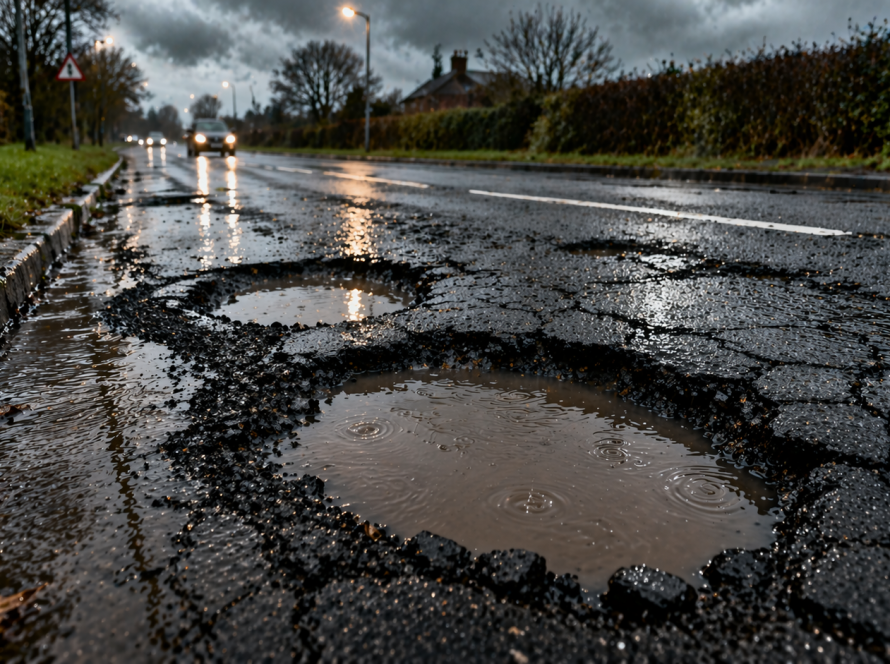
Another common indication is water collecting in the depressed area after rainfall.
You may also notice uneven joints, rocking blocks or a change in the level of the paving near drainage channels and other fixed features.
These symptoms should be assessed together rather than individually.
A small amount of surface unevenness does not necessarily indicate serious structural failure, but progressive settlement suggests that the supporting construction requires attention.
Can Sunken Block Paving Be Repaired?
In many situations, sunken block paving can be repaired without replacing the entire driveway.
One advantage of block paving is that individual sections can be lifted and reinstated.
However, the success of the repair depends on identifying and correcting the cause of settlement.
Repairing Localised Settlement
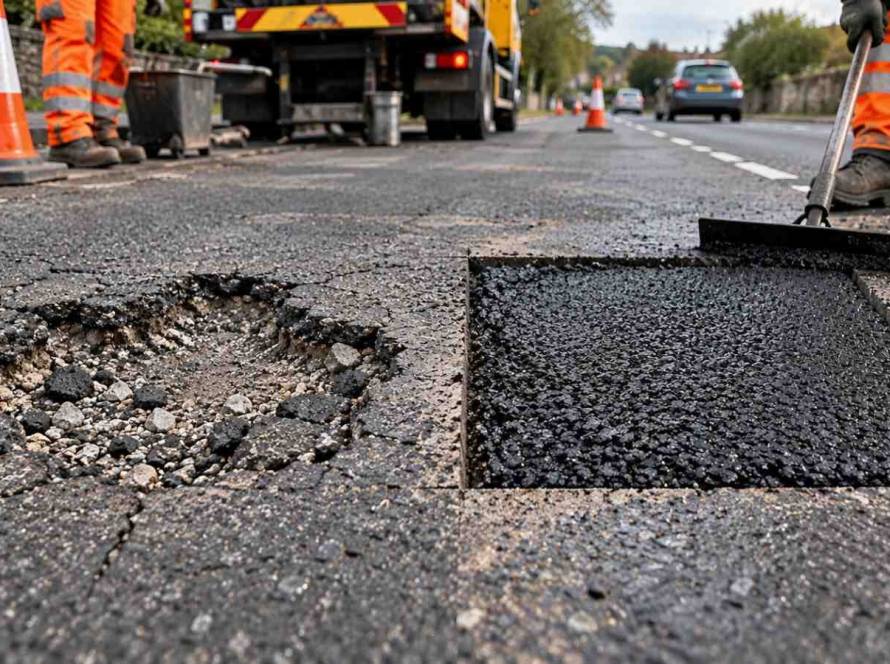
Where the problem is limited to a small area, the affected blocks can be carefully lifted to expose the laying course and underlying construction.
The contractor can then inspect the supporting layers and determine whether additional excavation or reconstruction is necessary.
If the sub-base has settled, simply adding more bedding material may only provide a temporary improvement.
A more durable repair may require removing unsuitable material, reconstructing the affected foundation and compacting it correctly before reinstating the paving.
The existing blocks can often be reused if they remain in suitable condition.
When More Extensive Work May Be Necessary
If settlement affects a large proportion of the driveway, isolated repairs may not be sufficient.
Widespread depressions can indicate that the original sub-base was inadequately constructed or that the underlying ground is unsuitable.
In these circumstances, more extensive reconstruction may be required.
The appropriate solution depends on the condition of the existing driveway, the extent of movement and the loads the finished surface must support.
Where repeated failures have occurred, property owners may also consider alternative surfacing systems, including professionally installed tarmac, provided the underlying structural issues are addressed.
How to Prevent Block Paving From Sinking
Preventing driveway settlement begins before the first paving block is installed.
The existing ground must be assessed, excavated to a suitable depth and prepared to support the proposed construction.
The sub-base should be selected and installed according to the expected traffic loading and site conditions.
Correct compaction is particularly important because it helps minimise subsequent movement.
The laying course should be installed at a consistent thickness, while the paving blocks must be properly positioned, jointed and compacted in accordance with the relevant system requirements.
Drainage and edge restraints also need to be incorporated into the design.
These principles are equally important in professional machine lay tarmac installations, where correct preparation and controlled construction help create durable surfaces capable of handling regular vehicle use.
Is Tarmac a Better Alternative to Block Paving?
Tarmac and block paving both have advantages, and neither material automatically eliminates the risk of settlement.
Block paving offers a distinctive appearance and allows individual sections to be lifted for repairs or underground access.
Tarmac provides a continuous surface and can be particularly suitable for larger driveways, access roads and areas requiring efficient installation.
However, both systems rely on a properly designed and constructed foundation.
Installing tarmac over unstable ground will not necessarily prevent future depressions or cracking.
Similarly, replacing sunken block paving without addressing the underlying cause may allow the same problem to return.
The most suitable surface depends on vehicle loading, drainage conditions, maintenance requirements, appearance and the intended use of the area.
Why Professional Ground Preparation Matters
The visible surface of a driveway represents only part of its overall construction.
Much of its long-term performance depends on the materials and workmanship beneath it.
A driveway may look attractive immediately after installation, but weaknesses in the foundation can take months or years to become apparent.
Professional preparation helps reduce this risk by ensuring that the supporting ground, sub-base and drainage arrangements are appropriate for the site.
Experienced surfacing contractors understand that different properties require different approaches.
A driveway constructed on stable, well-draining ground may have different requirements from one installed over clay, made ground or previously excavated areas.
Reviewing examples of completed driveway and surfacing projects can also help property owners understand the different finishes and construction applications available.
What Should You Do If Your Block Paving Has Started to Sink?
If your block paving is beginning to sink where you park your car, the first step is to establish whether the movement is localised or affects a wider section of the driveway.
A small depression may be associated with an isolated weakness in the laying course or sub-base. More extensive settlement can suggest broader problems with ground preparation, drainage or the original pavement construction.
The condition of the blocks, surrounding joints, drainage features and nearby ground should all be considered.
It is also important to determine whether the sinking is continuing. Progressive movement, recurring standing water or sudden settlement can indicate a problem requiring more detailed investigation.
Simply filling the depression with additional bedding material may improve the appearance temporarily, but it will not necessarily correct an unstable foundation.
For a lasting repair, the underlying cause must be identified and addressed.
Block paving sinking under car parking areas is therefore best understood as a pavement support issue rather than merely a cosmetic defect. With appropriate investigation, sound ground preparation and correctly constructed supporting layers, the affected area can often be restored to provide a stable and reliable driveway surface.