Industrial estates place unusually high demands on tarmac surfaces. Access roads, loading areas, service yards and parking zones may experience continuous vehicle movements throughout the working day, with HGVs, delivery vehicles, forklifts and staff traffic repeatedly using the same routes.
Over time, this level of use can lead to cracking, potholes, surface deformation, worn areas and drainage-related deterioration. The appropriate repair method depends on the condition of the existing tarmac, the cause of the damage and the type of traffic the surface needs to accommodate.
Understanding the available options for tarmac repairs for industrial estates helps site managers make informed decisions rather than repeatedly repairing visible defects without addressing the underlying problem.
Why Tarmac Deteriorates on Industrial Estates
Tarmac is designed to provide a durable running surface, but industrial environments can expose it to significantly greater stresses than an ordinary residential driveway.
Heavy vehicles are one of the most important considerations. A delivery vehicle travelling across an access road places substantial loads through its tyres, particularly when the same route is used repeatedly. Loading bays, entrances and junctions can experience even greater stress because vehicles frequently brake, accelerate and turn in these locations.
Turning movements are particularly demanding because tyres apply lateral forces to the surface rather than simply rolling across it. Over time, this can contribute to deformation, cracking and localised deterioration.
Water is another major factor. Once cracks or damaged areas allow water to enter the pavement construction, the supporting materials beneath the tarmac can become vulnerable. Repeated loading may then cause the weakened area to move, resulting in additional cracking, depressions or potholes.
A professional assessment should therefore consider more than the appearance of the damaged surface. Effective commercial road surfacing needs to account for vehicle loading, drainage, ground conditions and how different areas of an industrial estate are actually used.
Localised Pothole Repairs
Potholes are among the most obvious forms of damage on an industrial estate. They can create uncomfortable vehicle movements, collect standing water and present potential hazards to vehicles and pedestrians.
Where the surrounding tarmac remains structurally sound, a localised repair may be sufficient. The damaged material is removed so that the affected section can be properly reinstated rather than simply covering the hole with additional material.
Professional pothole repairs can be particularly useful where deterioration is limited to specific sections of an otherwise serviceable road, car park or yard.
The important consideration is why the pothole formed. If the defect resulted from an isolated area of damage, repairing that section may provide an effective solution. If numerous potholes are appearing across the same surface, however, repeated individual repairs may indicate that more extensive deterioration is taking place.
In that situation, continuing to patch each new defect can become inefficient. A wider assessment may reveal that resurfacing or reconstruction offers a more appropriate long-term approach.
Tarmac Patching for Damaged Sections
Not every damaged area forms a clearly defined pothole. Industrial tarmac can develop larger sections of cracking, fretting, deformation or general surface breakdown.
Patching allows these areas to be removed and replaced while leaving sound surrounding surfacing in place. It is a targeted method that can be useful where damage is concentrated around particular operational areas.
For example, the entrance to an industrial estate may deteriorate faster than a lightly used internal road. Loading areas and tight turning points may also experience more wear because heavy vehicles repeatedly manoeuvre over the same sections.
A properly planned patch repair should create a stable transition between the existing surface and the reinstated area. Preparation is particularly important because placing new material directly over loose or unstable tarmac is unlikely to provide a durable repair.
Crack Sealing and Early Intervention
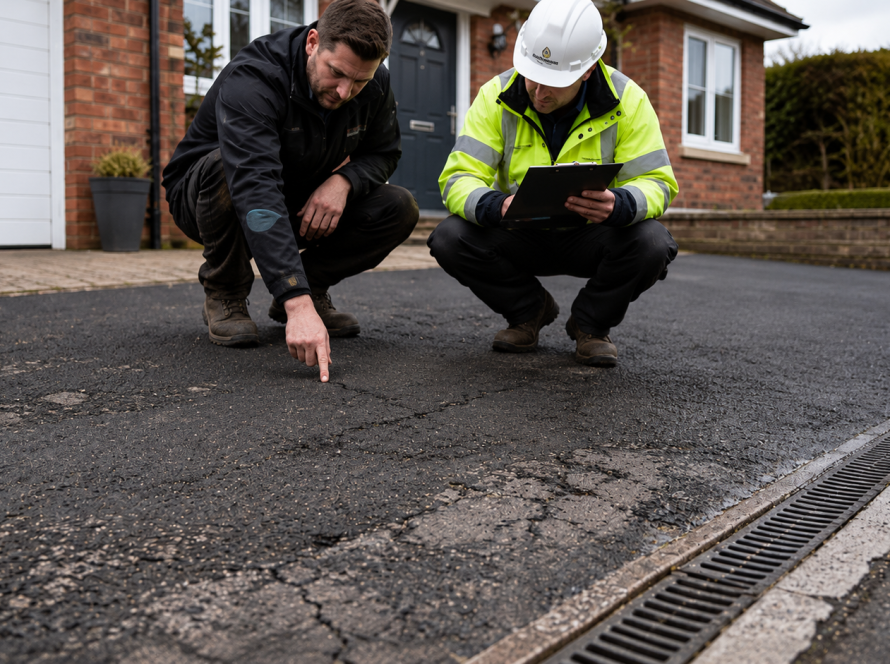
Cracks do not necessarily mean that an entire industrial road needs replacing. Their significance depends on their extent, pattern and underlying cause.
Where cracking is identified early and the surrounding construction remains stable, sealing vulnerable areas can help reduce water penetration. Preventing water from entering the pavement construction can slow further deterioration and extend the useful life of the existing surface.
This approach is most appropriate when defects are still relatively limited. Crack sealing should not be regarded as a substitute for structural repair where the tarmac is already moving, breaking apart or showing widespread deformation.
Site managers can benefit from inspecting industrial surfaces periodically rather than waiting until substantial potholes develop. Early maintenance is generally easier to manage operationally because smaller areas can often be treated with less disruption.
Resurfacing an Existing Industrial Road
When deterioration is widespread but the underlying construction remains suitable, resurfacing may be more appropriate than numerous individual patches.
Resurfacing generally involves preparing the existing area and installing a new tarmac layer to restore the running surface. The precise preparation required depends on the condition and levels of the existing pavement.
This option can provide a consistent finish across access roads, parking areas and other large industrial surfaces. It can also remove the patchwork appearance that develops after years of separate local repairs.
Professional tarmac installation and road surfacing should begin with an assessment of the existing construction. A new surface cannot permanently compensate for major instability underneath it.
Where the foundation remains sound, resurfacing can offer an efficient way to renew an ageing industrial road without reconstructing the entire pavement from the ground upwards.
Machine-Laid Tarmac for Larger Areas
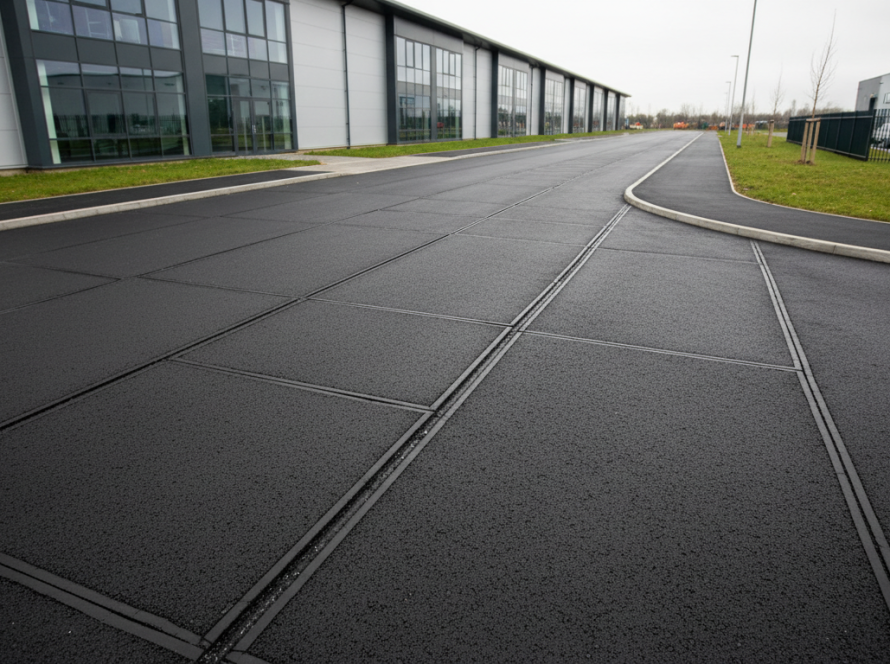
Industrial estates frequently contain substantial areas of surfacing. Long access roads, distribution yards and large parking areas require consistent material placement and compaction if they are to perform effectively.
For suitable sites, machine lay tarmac can provide controlled placement across larger areas. This helps produce a consistent surface profile and is particularly useful where extensive sections require resurfacing.
Machine laying does not remove the need for proper preparation. The quality of the finished tarmac still depends on the supporting construction, drainage, levels, material specification and compaction.
Access must also be considered. Some industrial estates contain restricted areas where machinery cannot operate effectively, meaning hand laying or a combination of methods may be required.
The repair specification should therefore reflect the physical characteristics of the site rather than applying the same installation method everywhere.
When Full Reconstruction Becomes Necessary
There comes a point where repairing the upper surface is no longer enough.
If an industrial road has extensive structural movement, deep depressions, widespread cracking or repeated failures in previously repaired areas, the supporting layers may need attention. Simply placing another layer of tarmac over an unstable foundation can hide the visible defects temporarily without resolving their cause.
Full reconstruction normally involves removing defective material and rebuilding the affected pavement to provide suitable support for the expected traffic.
This is a more substantial intervention, but it can be the appropriate option where the existing construction has reached the end of its useful life or was never designed for the loads now being imposed on it.
Industrial sites can change considerably over time. A road originally intended for occasional light commercial traffic may later become a regular HGV route following changes in occupancy or site operations. The existing pavement may consequently be inadequate even if it was suitable when first constructed.
Drainage Problems Should Be Addressed During Repairs
Standing water is an important warning sign on an industrial estate.
Water collecting in wheel tracks, depressions or beside kerbs may indicate that surface levels or drainage arrangements are no longer working correctly. Allowing these problems to remain can contribute to continued deterioration.
Repairing a pothole without considering why water repeatedly gathers in the same location may only address part of the problem.
Drainage should therefore form part of the assessment when planning tarmac repairs for industrial estates. Existing channels, gullies and falls need to be considered alongside the surfacing itself.
Where resurfacing is planned, establishing suitable levels can help direct water towards the intended drainage system rather than allowing it to remain on heavily trafficked areas.
Repairing Loading Bays and Turning Areas
Loading bays, service yards and turning areas often require particular attention because they experience concentrated vehicle forces.
A heavy vehicle travelling in a straight line applies a different type of stress from one performing a tight turn while heavily loaded. Braking, steering and acceleration can all increase the forces acting across the tarmac.
Damage in these locations may therefore appear before deterioration elsewhere on the estate.
Repeated patching can be appropriate where the affected area is small and the supporting construction remains sound. Where deformation continually returns, however, the repair may need to extend deeper so that the pavement can properly support the operational demands placed upon it.
The expected vehicle types and movement patterns should be considered when specifying the repair rather than treating the area in the same way as a lightly trafficked parking space.
Phasing Repairs to Keep an Industrial Estate Operational
Closing an entire industrial estate for surfacing work is rarely practical.
Businesses may require continuous deliveries, employees need access to units and emergency routes must remain available. Repair planning therefore needs to consider site operations as carefully as the surfacing work itself.
Larger projects can often be completed in phases so that traffic is redirected while individual sections are repaired. Access to particular units can be coordinated around working hours, deliveries or periods of reduced activity.
Phasing can be particularly useful where a combination of repair methods is required. One section may need localised pothole repairs while another requires resurfacing or deeper reconstruction.
Experienced contractors providing surfacing services can assess both the physical condition of the site and the practical requirements for carrying out the work safely with manageable disruption.
Choosing Between Repair and Resurfacing
The decision between local repair and wider resurfacing should be based on the overall condition of the pavement.
If an access road is generally sound with one or two isolated defects, targeted repairs may provide everything required. Removing a large quantity of serviceable tarmac would offer little benefit in that situation.
The calculation changes when cracking, potholes and deformation are spread across substantial sections of the estate. Carrying out numerous separate patches may require repeated closures and leave the site needing further repairs relatively quickly.
Resurfacing can become more appropriate when the upper layer has deteriorated extensively but the underlying construction is still suitable. Reconstruction should be considered where failure extends into the supporting pavement layers.
The objective is not simply to choose the largest repair method. It is to match the intervention to the actual condition and expected future use of the surface.
Why the Sub-Base Matters
Although drivers only see the finished tarmac, much of an industrial road’s ability to support traffic comes from the construction underneath.
The sub-base distributes loads and provides a stable foundation for the layers above. If it becomes weak, poorly compacted or saturated, movement can eventually appear at the surface.
This is why recurring defects deserve investigation. A patch that repeatedly sinks or cracks may be indicating a deeper weakness rather than a problem confined to the visible tarmac.
Where necessary, defective supporting material should be removed and reinstated before new surfacing is placed. Repairing the underlying weakness helps prevent the new surface from simply reproducing the same defect.
Planning Tarmac Repairs for Long-Term Performance
Effective tarmac repairs for industrial estates begin with understanding the site as a complete working environment.
The condition of the existing surface needs to be considered alongside traffic volumes, vehicle weights, turning movements, drainage, access restrictions and the condition of the construction beneath the tarmac.
Localised pothole repairs and patching can be effective where defects are isolated. Crack treatment may help protect surfaces where deterioration is identified early. Resurfacing can restore larger worn areas where the underlying pavement remains suitable, while full reconstruction may be required when structural failure has developed.
There is therefore no single repair method that suits every industrial estate.
The most appropriate approach is to identify the extent and cause of the damage before deciding how much of the pavement needs intervention. This allows repair work to address genuine weaknesses, maintain safe access and provide a surface capable of supporting the estate’s continuing commercial use.