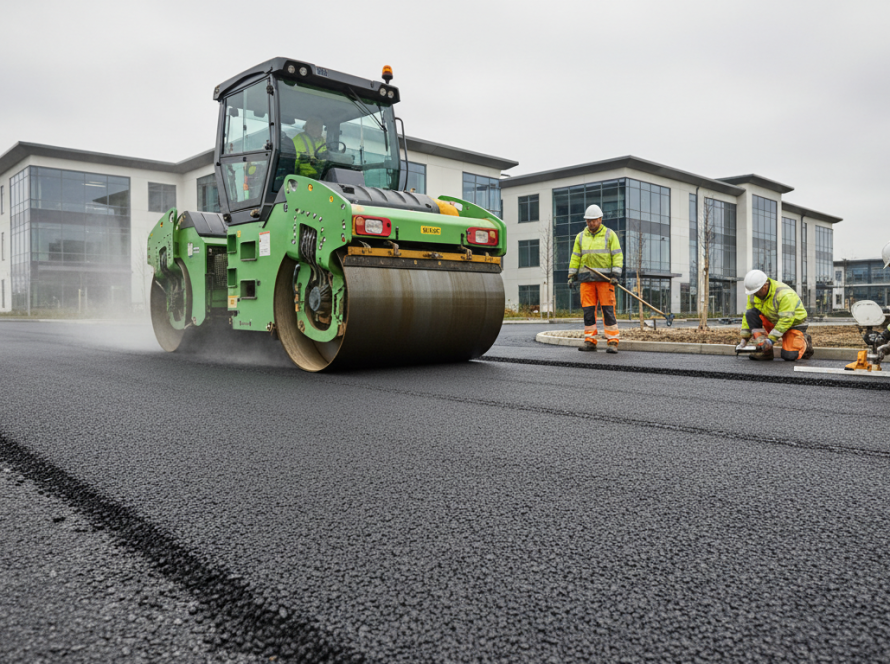
Edge restraints are one of the most overlooked parts of a road construction project, yet they play a major role in the long-term durability of the finished surface. In many cases, early cracking and deterioration are not caused by the surface material itself but by poor structural support at the road edges. Without effective restraint, the surface gradually weakens under pressure, eventually leading to visible defects and expensive repairs.
In road surfacing projects across the UK, edge restraints help maintain the shape and stability of the road structure. They prevent lateral movement within the surfacing layers and help distribute traffic loads more evenly across the carriageway. When installed correctly, they significantly reduce the risk of cracking, edge collapse, and deformation.
Many commercial and private access roads experience early surface failure because insufficient attention was given to edge support during construction. Proper commercial road surfacing requires a fully integrated structure where the surface, sub-base, drainage, and restraints all work together.
What Are Edge Restraints in Road Construction?
Edge restraints are structural components installed along the sides of a road or paved area to secure the surfacing materials and maintain structural integrity. They are commonly constructed using concrete kerbs, reinforced edging systems, or other rigid containment methods designed to prevent movement within the road layers.
Their primary purpose is to hold the road structure in place. Asphalt and tarmac surfaces naturally expand, contract, and flex under traffic loading and changing weather conditions. Without firm support at the edges, this movement gradually weakens the surface and allows cracking to develop.
In the UK, roads that experience regular heavy traffic are especially vulnerable to edge failure when restraints are poorly designed or omitted entirely. Industrial estates, service yards, private developments, and access roads often require reinforced edging systems to handle ongoing stress from turning vehicles and concentrated wheel loads.
Professional tarmac installation includes careful consideration of edge stability during both the planning and construction stages.
How Poor Edge Restraints Lead to Cracking
Road surfaces rely on confinement to maintain strength. When edge restraints fail or are not properly installed, the surfacing layers begin to spread sideways under traffic pressure. This lateral movement weakens the structural bond between layers and creates stress points throughout the road surface.
Cracking often begins near the road edges because these areas experience the greatest movement. Small fractures then develop into larger structural problems as water enters the surface and weakens the underlying layers.
Repeated traffic loading accelerates this process. Heavy vehicles place substantial pressure on unsupported edges, particularly during turning movements or when vehicles partially leave the carriageway. Over time, unsupported sections begin to break away, leading to crumbling edges, potholes, and longitudinal cracking.
Roads constructed without suitable edge support can deteriorate far earlier than expected, even if the surface material itself was installed correctly. This is why experienced contractors treat edge restraint design as a critical part of any surfacing project rather than a minor finishing detail.
The Relationship Between Edge Restraints and Sub-Base Stability
Edge restraints do more than support the visible road surface. They also help stabilise the sub-base beneath the surfacing layers. The sub-base forms the structural foundation of the road, distributing loads and preventing settlement. If the edges of the sub-base are not properly contained, the material can shift outward over time.
As the sub-base moves, voids begin to develop beneath the surface. This loss of support allows flexing within the asphalt layers, eventually leading to fatigue cracking and surface deformation.
Poor edge support is particularly problematic in areas with weak ground conditions or frequent heavy traffic. Commercial access roads and industrial sites often require deeper sub-base construction combined with reinforced edging systems to prevent movement under load.
High-quality machine lay tarmac installations depend on a stable foundation with effective edge containment to maintain long-term structural performance.
Water Ingress and Edge Failure
One of the most damaging consequences of poor edge restraints is increased water penetration. Once cracking begins near unsupported edges, rainwater can enter the road structure and weaken the lower layers.
Water infiltration softens the sub-base and reduces load-bearing capacity. During colder weather, freeze-thaw cycles can further expand existing cracks and accelerate deterioration. Over time, sections of the road may begin to sink, rut, or break apart completely.
Proper edge restraint systems help prevent water from entering vulnerable areas by maintaining surface integrity and supporting effective drainage performance. Roads that lack sufficient edge protection are far more likely to develop drainage-related defects early in their lifespan.
Effective road construction therefore requires a combination of stable edging, proper compaction, and suitable drainage planning. Surface water management should always be considered alongside structural support measures during project design.
Common Signs of Edge Restraint Failure
Early signs of edge restraint problems are often visible before major structural damage develops. Recognising these warning signs can help property owners and site managers address issues before expensive reconstruction becomes necessary.
Road edges may begin to crumble or break away under traffic pressure. Cracks can appear parallel to the edge of the carriageway, particularly in areas where vehicles frequently turn or overrun the surface. In some cases, the road edge may sink lower than the surrounding ground due to loss of sub-base support.
Surface spreading is another common indicator. The asphalt may gradually move sideways, creating uneven edges and visible deformation. Drainage problems may also appear as water becomes trapped in depressions caused by structural movement.
Regular inspections are important for identifying these issues early. Prompt repairs can often prevent more extensive deterioration and reduce long-term maintenance costs.
When deterioration becomes severe, professional pothole repairs may be required to restore structural integrity and prevent further damage.
Why Commercial Roads Are More Vulnerable
Commercial roads and access routes are exposed to significantly higher traffic stresses than many residential surfaces. Delivery vehicles, HGVs, forklifts, and service traffic place concentrated pressure on road edges during manoeuvring and loading operations.
This repeated stress increases the importance of strong edge restraint systems. Even minor weaknesses can quickly develop into major structural failures when subjected to constant heavy loading.
Business parks, industrial estates, logistics centres, and construction access roads all require carefully engineered surfacing systems designed to withstand long-term operational demands. Edge restraints are a fundamental part of this process.
Experienced contractors assess expected traffic volumes, vehicle weights, turning patterns, and drainage requirements before determining the most appropriate restraint system for a site. Without this planning, roads may suffer premature failure despite substantial investment in surfacing works.
Property owners investing in our surfacing services benefit from a more complete approach that considers the entire road structure rather than focusing only on the surface finish.
The Importance of Professional Installation
Even high-quality materials can fail if edge restraints are installed incorrectly. Accurate excavation depths, suitable foundations, and proper compaction are all essential for achieving long-term performance.
Poor workmanship can leave restraints unstable or unable to resist traffic forces effectively. Inadequate alignment may also create weak points where movement and cracking can begin.
Professional contractors understand how different site conditions affect edge restraint performance. Factors such as soil type, drainage conditions, traffic loading, and surface gradients all influence the design and installation process.
Careful preparation and quality control are essential at every stage of the project. Reliable contractors ensure that restraints are properly integrated into the overall road structure to provide lasting support and durability.
Examples of completed projects can often demonstrate the value of correct installation standards and long-term structural planning. Reviewing a contractor’s surfacing portfolio can provide useful insight into the quality and scope of previous work.
Long-Term Cost Benefits of Proper Edge Restraints
Although edge restraints increase initial construction costs slightly, they often deliver significant savings over the lifespan of the road. Preventing early cracking reduces the need for ongoing repairs, patching, and resurfacing.
Roads with effective structural support generally maintain their condition for longer and experience fewer maintenance disruptions. This is particularly important for commercial premises where road closures or access restrictions can affect operations.
Well-constructed edge restraints also improve safety by reducing the likelihood of edge collapse, potholes, and uneven surfaces. This helps maintain a safer environment for vehicles, pedestrians, and site users.
Long-term road performance depends on the quality of the entire structure, not simply the visible surface layer. Investing in proper edge support during construction is one of the most effective ways to improve durability and reduce future maintenance liabilities.