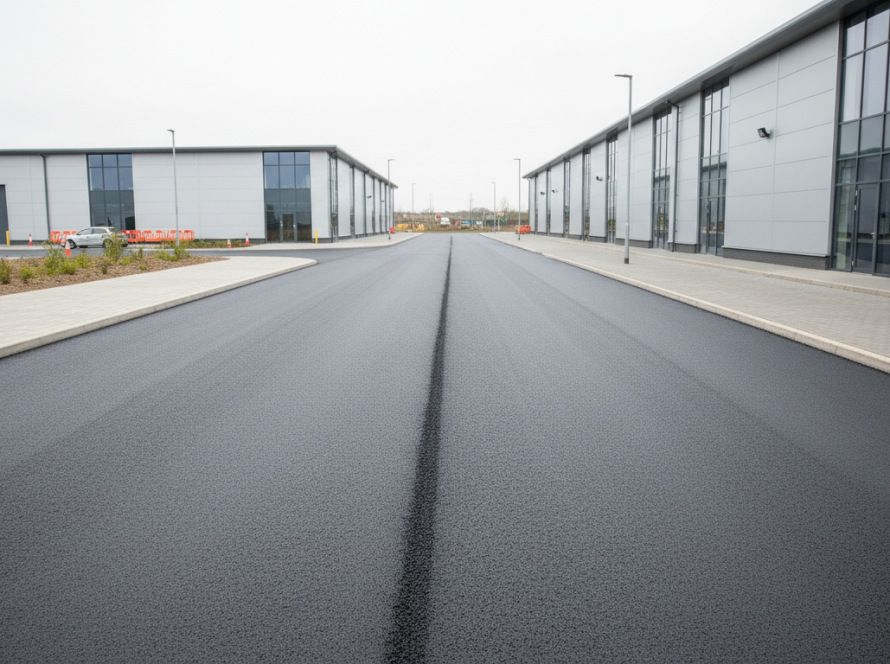
Commercial surfaces are rarely subjected to the same conditions as an ordinary residential driveway. Industrial estates, warehouses, distribution centres, factories and service yards can experience continuous vehicle movements throughout the working day, often involving loaded forklifts and heavy goods vehicles.
The effect of this traffic is not limited to the weight of an individual vehicle. How vehicles move, where they turn, how frequently they use the surface and where they remain stationary can all influence deterioration.
For this reason, commercial surfacing heavy vehicles UK requirements should be considered during the design and preparation stages rather than after problems become visible. A properly constructed surface needs to distribute loads effectively while resisting the stresses created by braking, turning and repeated trafficking.
Professional commercial surfacing and road surfacing should therefore reflect the actual operating conditions of the site. A warehouse entrance used by occasional delivery vehicles has very different requirements from a busy logistics yard handling HGV movements throughout the day.
How HGV Weight Affects a Commercial Surface
Heavy goods vehicles place substantial loads onto the pavement structure through relatively small tyre contact areas. When these loads are repeated over months and years, weaknesses within the surface, base or sub-base can become increasingly apparent.
A well-designed commercial surface does more than provide a smooth top layer. The construction beneath the visible surface plays an essential role in transferring vehicle loads into the ground.
If the underlying layers are inadequate, repeated HGV traffic can contribute to deformation, depressions and cracking. These problems can then affect drainage and create areas where water collects.
Repeated Loading Matters as Much as Individual Vehicle Weight
A single HGV movement does not necessarily cause obvious damage to a correctly constructed surface. The more important consideration is often the cumulative effect of repeated traffic.
A commercial access road receiving a small number of deliveries each week will experience different loading from a distribution facility handling hundreds of vehicle movements. Traffic frequency therefore needs to be considered alongside vehicle type.
Repeated loading can gradually expose weaknesses that were not immediately visible following installation. This is one reason why appropriate construction depth, material selection and compaction are particularly important on heavily trafficked commercial sites.
Forklifts Create Concentrated Surface Stress
Forklifts present a different challenge from HGVs. Although considerably smaller, they can carry substantial loads and transfer them through relatively small tyres.
This concentrated loading can place considerable stress on localised areas of a commercial surface. Forklifts also tend to follow repetitive routes between warehouse doors, storage areas, loading bays and vehicles, meaning the same sections of surfacing may receive intensive use every day.
The condition of these routes can directly affect day-to-day site operations. Depressions, cracks and potholes may make forklift movements less comfortable and can allow water to penetrate into the pavement construction.
Where operating conditions justify it, professionally installed machine-laid tarmac can help provide a consistent surface across larger commercial areas. The suitability of any construction method, however, depends on the site, expected traffic and underlying ground conditions.
Turning and Braking Increase Surface Stress
Vehicle weight is only one part of the issue. Horizontal forces created by turning, braking and acceleration can be particularly demanding on commercial surfacing.
HGVs regularly make tight manoeuvres around loading bays, warehouse entrances and service yards. When a heavy vehicle turns slowly, its tyres can scrub against the surface rather than simply rolling across it.
This action creates additional stress within the surface course. Repeated in the same location, it can contribute to localised deterioration.
Forklifts can produce similar effects because they frequently make sharp turns within confined operational areas. Junctions, loading zones and turning points can therefore deteriorate differently from straight sections of access road.
Particular Attention Is Needed Around Turning Areas
The layout of a commercial site can create predictable areas of concentrated stress. Entrance gates, junctions, loading bays, reversing zones and tight corners often receive more demanding traffic movements than other areas.
Surfacing design should take these patterns into account. Simply applying the same construction approach across every part of a large commercial site may not adequately reflect how different areas will actually be used.
Appropriate tarmac installation and road surfacing should consider both the expected traffic load and the way vehicles will move through the site.
The Importance of the Sub-Base
The visible surface is only part of a commercial pavement system. Its long-term performance depends heavily on what lies underneath.
The sub-base provides structural support and helps distribute vehicle loads. If it is poorly prepared, inadequately compacted or unsuitable for the expected traffic, the finished surface can become vulnerable to movement.
Under regular HGV traffic, insufficient support may eventually lead to depressions or cracking. Once deformation occurs, water can begin collecting in low areas, potentially increasing deterioration.
Ground preparation should therefore reflect the intended use of the site. Commercial areas carrying heavy vehicles generally require greater consideration of structural support than lightly trafficked spaces.
Compaction and Consistency Are Critical
Proper compaction helps create a stable pavement structure. This applies to both underlying materials and the asphalt or tarmac layers above.
Insufficient compaction can leave a surface more susceptible to movement under traffic. Heavy vehicles repeatedly passing across the same areas can accelerate this process.
Consistency is also important on larger commercial projects. Irregularities in construction can create localised weak points, which may become more apparent once forklifts and HGVs begin using the area.
Professional surfacing services should therefore consider preparation, laying and compaction as connected parts of the construction process rather than treating the visible finish as the only measure of quality.
Drainage Becomes Even More Important Under Heavy Traffic
Commercial surfaces need effective drainage regardless of vehicle type, but water can become particularly problematic when heavy traffic has created depressions or damaged areas.
Standing water can enter cracks and defects within the surface. Over time, moisture can affect underlying materials and contribute to further deterioration.
Heavy vehicle movements may then place additional stress on already weakened sections. This can create a cycle in which minor surface defects progressively become more substantial.
Maintaining suitable gradients and drainage routes is therefore important when designing commercial access roads, yards and loading areas. Water should be directed away efficiently rather than being allowed to remain within heavily trafficked zones.
Loading Bays Require Particular Attention
Loading bays combine several demanding conditions in a relatively small area. HGVs approach slowly, turn, reverse, brake and remain stationary while loading or unloading takes place.
These repeated movements concentrate stress within predictable sections of the surface. Forklifts may also move between the warehouse and parked vehicles, increasing traffic intensity.
As a result, loading areas should be considered separately when assessing commercial surfacing heavy vehicles UK requirements. The construction needs to reflect the frequency and type of traffic rather than simply the overall size of the yard.
Careful planning at the installation stage can help ensure that areas experiencing the greatest operational demands receive appropriate preparation and surfacing.
What Happens When Commercial Surfacing Is Under-Specified?
A surface that is unsuitable for its actual traffic conditions may initially appear satisfactory. Problems often develop gradually as repeated vehicle movements expose weaknesses.
Depressions can form in wheel paths, cracks may appear around stressed areas and potholes can develop where surface damage allows water into the pavement structure.
Once defects become established, they can affect more than appearance. Uneven surfaces may interfere with drainage, create uncomfortable forklift routes and require repeated maintenance.
Timely pothole repairs can address localised defects before they become more extensive, although recurring damage may indicate that the underlying cause also needs investigation.
Existing Commercial Surfaces Should Be Assessed Before Upgrading
Not every worn commercial surface requires complete reconstruction. The appropriate approach depends on the extent of deterioration and the condition of the supporting pavement layers.
Where an existing base remains structurally suitable, resurfacing may provide an effective way to restore the operating surface. Where there is significant movement or widespread structural failure, more substantial preparation may be necessary.
This distinction is particularly important on sites where traffic patterns have changed. A yard originally designed for light commercial vehicles may later become a regular route for articulated HGVs or heavily loaded forklifts.
In such circumstances, the previous construction may no longer match the demands placed upon it.
Commercial Surfacing Should Reflect Actual Site Operations
There is no single surfacing specification that is appropriate for every commercial site. A retail service road, manufacturing facility, distribution centre and industrial estate can all experience very different traffic conditions.
An effective assessment should consider expected vehicle types, traffic frequency, turning movements, braking zones, loading areas, drainage and the condition of the existing ground.
Understanding these factors allows the pavement construction to be matched more closely to its intended use.
Examples of completed surfacing projects can also help property owners and site managers understand how professional surfacing is applied across different environments.
Protecting Commercial Surfaces Over the Long Term
Good construction provides the foundation for durability, but ongoing observation remains important once a commercial surface is in service.
Site managers should pay attention to areas where heavy vehicles repeatedly turn, brake or stand. Early signs of cracking, localised deformation or water retention can indicate that a particular section is experiencing greater stress than anticipated.
Addressing defects before they become widespread can reduce disruption and prevent localised deterioration from affecting surrounding areas.
For sites handling forklifts and HGVs, durable surfacing ultimately depends on matching the construction to real operating conditions. Vehicle weight matters, but so do traffic frequency, tyre movements, turning patterns, drainage, ground preparation and compaction.
When these factors are considered together, commercial surfacing can provide a stable and practical working surface capable of supporting demanding vehicle movements while reducing the likelihood of premature failure.