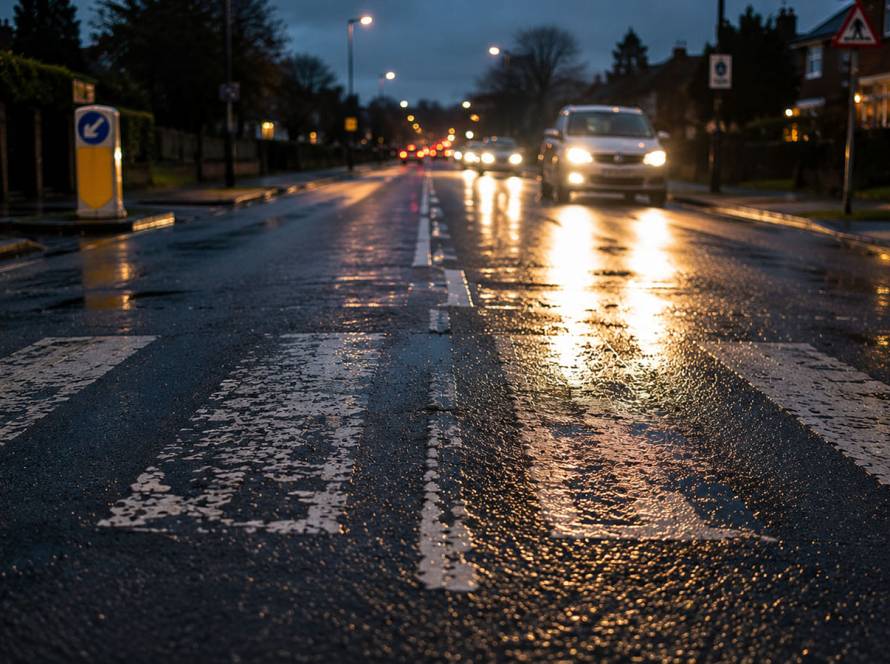
Heavy vehicles place considerable pressure on tarmac roads, particularly in commercial yards, industrial estates, loading bays and access routes used by delivery lorries. Over time, this repeated pressure can cause visible depressions to develop along vehicle wheel paths. These depressions are known as rutting.
Heavy vehicle tarmac rutting is a common problem across UK commercial sites, especially where road construction has not been designed to accommodate regular HGV traffic. Although tarmac is a durable and flexible surfacing material, its long-term performance depends on the strength of the underlying construction, the suitability of the asphalt mixture and the conditions in which vehicles operate.
Understanding why rutting develops allows property owners, facilities managers and commercial site operators to identify early warning signs, assess potential structural weaknesses and make informed decisions about maintenance or resurfacing.
What Is Rutting in Tarmac Roads?
Rutting is a form of permanent surface deformation that creates longitudinal depressions in the areas where vehicle tyres repeatedly travel.
Unlike temporary movement caused by loading, rutting remains visible after vehicles have passed. The affected surface may develop shallow grooves, uneven wheel tracks or more substantial depressions that interfere with drainage and vehicle movement.
On commercial roads, rutting commonly appears near site entrances, loading bays, delivery routes and areas where heavy vehicles follow consistent traffic patterns.
The depth and severity of these depressions depend on several factors, including traffic volume, axle loading, asphalt composition, pavement thickness and the condition of the supporting ground.
Minor rutting may initially appear to be a cosmetic issue. However, progressive deformation can indicate that the road structure is struggling to distribute vehicle loads effectively.
If left unaddressed, rutting can contribute to standing water, surface cracking and accelerated deterioration.
Why Heavy Vehicles Cause Tarmac Rutting
Heavy vehicles affect tarmac differently from ordinary passenger cars because they impose significantly greater loads on the road structure.
A commercial vehicle transfers its weight through its tyres into the asphalt layers and the supporting foundation. Although this pressure spreads through the pavement, the materials must be sufficiently strong to resist permanent deformation.
Repeated Heavy Axle Loads
One of the primary causes of heavy vehicle tarmac rutting is repeated axle loading.
HGVs, refuse collection vehicles, agricultural machinery and construction vehicles can impose substantial loads on relatively concentrated areas of road surface.
When these vehicles repeatedly travel along the same wheel paths, the pavement experiences thousands of loading cycles.
If the asphalt mixture or supporting layers are unable to withstand these repeated stresses, permanent deformation gradually accumulates.
The problem is particularly noticeable on access roads where vehicles follow predictable routes rather than spreading their movements across the full carriageway width.
A road that performs adequately under occasional heavy traffic may deteriorate much faster when the frequency of HGV movements increases.
Slow-Moving and Stationary Vehicles
Vehicle speed also influences rutting.
Slow-moving heavy vehicles can create demanding loading conditions because the asphalt remains under pressure for longer periods.
This is particularly relevant around security gates, weighbridges, loading areas and junctions where lorries frequently stop, queue or accelerate.
Asphalt behaves as a viscoelastic material, meaning its response to loading depends partly on temperature and how long the load is applied.
When heavy vehicles remain stationary or move slowly over vulnerable asphalt, the risk of permanent deformation can increase.
Repeated braking and acceleration may also introduce horizontal forces that contribute to surface movement and distortion.
Concentrated Traffic Patterns
Commercial access roads often have limited carriageway widths, meaning vehicles repeatedly use almost identical wheel tracks.
This concentrates loading into narrow sections of the pavement.
Over time, these areas experience greater accumulated stress than surrounding sections.
Rutting may therefore develop in two distinct parallel lines while the central section of the road remains comparatively level.
This pattern is frequently observed on industrial estate roads, distribution centre entrances and private service roads.
How Poor Road Construction Contributes to Rutting
Heavy vehicles are not necessarily the sole cause of rutting. In many cases, deformation occurs because the road structure was not designed or constructed for the loads it now carries.
Effective commercial road surfacing requires careful consideration of traffic loading, ground conditions, material selection and construction depth.
Insufficient Sub-Base Strength
The sub-base plays an important role in supporting the asphalt layers and distributing traffic loads into the ground below.
If this layer is too thin, poorly compacted or constructed from unsuitable material, it may gradually deform under repeated heavy traffic.
As the supporting structure settles, the tarmac above can follow the same movement, creating depressions along wheel paths.
This type of rutting is particularly concerning because replacing the surface alone may not resolve the underlying problem.
Where deformation originates within the foundation, effective repairs may require excavation and reconstruction of the affected pavement layers.
Inadequate Asphalt Thickness
Roads intended for light vehicles generally require different structural designs from roads carrying regular commercial traffic.
If a road has insufficient asphalt thickness for its actual loading conditions, repeated vehicle movements may overstress the pavement.
This can result in deformation within the asphalt layers or excessive movement in the supporting foundation.
The required pavement thickness depends on traffic loading, material properties, ground strength and design life rather than a single standard measurement suitable for every site.
Professional tarmac installation should therefore account for how the road will be used throughout its expected service life.
Poor Compaction During Installation
Compaction is essential for achieving the required density and stability of asphalt.
During installation, the material must be compacted appropriately while it remains within a suitable working temperature range.
Insufficient compaction can leave excessive air voids and reduce the pavement’s resistance to traffic loading.
When heavy vehicles begin using the road, additional densification may occur within the wheel paths, producing permanent depressions.
Correct installation procedures, including suitable laying equipment and controlled compaction, help reduce this risk.
For larger commercial projects, machine-laid tarmac can support consistent placement and thickness control, although the finished performance still depends on appropriate compaction and quality assurance.
How Temperature Affects Tarmac Rutting
Temperature has a significant influence on asphalt behaviour.
Tarmac is designed to remain sufficiently flexible to accommodate normal traffic loading and environmental changes. However, its resistance to deformation can decrease as temperatures rise.
Asphalt Softening During Warm Weather
During warmer conditions, the bituminous binder within asphalt becomes less stiff.
This does not mean the surface melts under ordinary British summer temperatures. Instead, the material becomes more susceptible to deformation when exposed to sustained or repeated heavy loading.
Road surface temperatures can also be considerably higher than the surrounding air temperature, particularly in direct sunlight.
Commercial roads carrying slow-moving HGVs may therefore experience increased rutting risk during prolonged warm periods.
Appropriate asphalt mixture design is important where high loading and elevated pavement temperatures are expected.
Why Summer Conditions Expose Existing Weaknesses
Warm weather often reveals weaknesses that already exist within a road structure.
An asphalt surface that has been inadequately compacted or constructed using an unsuitable mixture may perform reasonably under moderate conditions but begin deforming when temperatures rise.
Heavy vehicles can accelerate this process, particularly where wheel loads remain concentrated.
This is why rutting should not automatically be attributed to hot weather alone.
Temperature may contribute to the problem, but the underlying cause frequently involves a combination of pavement design, material performance and traffic loading.
The Role of Drainage in Road Surface Deformation
Drainage is another important consideration when investigating rutting in tarmac roads.
Although asphalt surfacing can provide a relatively water-resistant running surface, moisture may still enter the pavement through cracks, joints, damaged edges or defects.
If water accumulates within the supporting layers, the strength of the road foundation can decrease.
Water Weakening the Supporting Ground
Poor drainage can allow water to penetrate the sub-base and underlying soil.
Some ground materials become significantly weaker when saturated, reducing their ability to support repeated vehicle loading.
Under heavy traffic, the weakened foundation may deform, causing the pavement above to settle into visible wheel tracks.
This type of damage can become progressively worse during prolonged wet weather.
Standing Water Within Existing Ruts
Rutting can also create additional drainage problems.
As depressions develop, rainwater may collect in the wheel paths instead of flowing towards the intended drainage outlets.
Standing water can increase the risk of water entering existing cracks and defects.
During colder weather, freeze-thaw action may contribute to further deterioration where water has penetrated vulnerable pavement layers.
For commercial site managers, visible standing water within wheel tracks should therefore be treated as a potential warning sign rather than simply a surface inconvenience.
Why Rutting Is Common in Loading Bays and Industrial Estates
Loading bays and industrial estates experience particularly demanding traffic conditions.
Unlike ordinary roads, these environments often combine heavy axle loads, frequent braking, tight turning movements and prolonged stationary loading.
Delivery vehicles may repeatedly approach loading doors using the same wheel paths, while articulated lorries create additional stresses during manoeuvring.
At turning points, tyres can impose significant horizontal forces on the surface.
Where vehicles stop in fixed positions, concentrated loading may produce localised depressions.
These operating conditions make appropriate pavement design especially important.
A commercial yard intended for frequent HGV use should not automatically be constructed to the same specification as a lightly trafficked private driveway.
The design should reflect the expected vehicle types, loading frequency, manoeuvring requirements and ground conditions.
How to Identify Early Signs of Tarmac Rutting
Rutting often develops gradually, making early identification valuable.
The first indication may be a slight depression along a frequently used vehicle route.
As deformation progresses, the wheel tracks become more noticeable, particularly after rainfall.
Water collecting in two parallel lines can indicate that the surface profile has changed.
Site managers may also notice uneven vehicle movement, surface distortion near junctions or raised ridges alongside depressed wheel paths.
In some cases, cracking begins to develop around the affected areas as the pavement experiences additional stress.
Not every depression indicates the same type of failure.
Rutting caused by asphalt densification differs from deformation caused by instability within the asphalt mixture or settlement of the underlying foundation.
Determining which mechanism is responsible is essential before selecting a repair method.
Can Rutting in Tarmac Roads Be Repaired?
Rutting can often be repaired, but the appropriate treatment depends on its depth, extent and underlying cause.
A surface-level repair may be suitable where the deformation is limited to the upper asphalt layer and the remaining pavement structure is sound.
More substantial damage may require removal and reconstruction of several pavement layers.
Localised Surface Repairs
Where rutting is shallow and the underlying construction remains stable, targeted resurfacing may restore the required profile.
The affected material can be removed and replaced using an appropriate asphalt mixture.
However, simply filling a rut without investigating the cause may provide only a temporary improvement.
If repeated heavy loading continues to exceed the pavement’s capacity, deformation may return.
Full-Depth Reconstruction
Where rutting results from inadequate foundation strength, deeper reconstruction may be necessary.
This can involve removing the damaged asphalt, examining the supporting layers and replacing unsuitable materials.
The reconstructed pavement should be designed to accommodate the expected commercial traffic.
Although this approach involves more extensive work, it addresses structural weaknesses that surface treatments cannot correct.
Addressing Associated Surface Damage
Rutting may occur alongside cracking, edge deterioration and pothole formation.
Where these defects are present, appropriate pothole repairs can help restore localised damaged areas, but any underlying structural movement must also be considered.
Repairing individual defects without addressing the cause of pavement deformation can lead to recurring maintenance requirements.
How to Prevent Heavy Vehicle Rutting in New Tarmac Roads
Preventing rutting begins with understanding the demands that commercial traffic will place on the pavement.
A road intended for regular HGV movements requires an appropriate combination of foundation strength, asphalt thickness, material performance and drainage.
Designing for Actual Traffic Loads
Pavement design should reflect the vehicles expected to use the road rather than relying solely on its appearance or intended general purpose.
The number of heavy vehicle movements, axle configurations and expected service life all influence structural requirements.
Future changes in site operations should also be considered.
For example, a commercial property originally receiving occasional deliveries may later accommodate frequent articulated lorry movements.
If traffic loading increases significantly, the existing pavement may no longer provide sufficient structural capacity.
Selecting Suitable Asphalt Materials
Different asphalt mixtures offer different performance characteristics.
For heavily trafficked areas, material selection should account for resistance to permanent deformation, expected loading conditions and pavement temperature.
Suitable aggregate grading, binder properties and mixture design all contribute to rutting resistance.
The objective is to provide a durable surface that balances stability, flexibility and long-term performance.
Ensuring Effective Construction Quality
Even a well-designed pavement can perform poorly if construction standards are inadequate.
Correct ground preparation, suitable material placement, consistent layer thickness and effective compaction are essential.
Drainage arrangements should also prevent unnecessary moisture accumulation within the pavement structure.
Quality control during installation helps ensure the completed road performs as intended under commercial traffic.
When Should Commercial Site Managers Investigate Rutting?
Not every shallow wheel-track depression requires immediate full reconstruction.
However, rutting should be investigated when it becomes progressively deeper, creates persistent standing water or begins affecting vehicle movements.
Additional warning signs include cracking alongside wheel paths, repeated pothole formation and visible settlement around loading areas.
A site assessment can help determine whether deformation is confined to the asphalt surface or extends into the supporting pavement layers.
Depending on the severity of the problem, investigation may involve measuring rut depth, examining drainage conditions, reviewing traffic loading and undertaking pavement testing or trial excavations.
This information allows repair recommendations to address the actual cause rather than relying on the appearance of the damage alone.
Long-Term Management of Tarmac Roads Used by Heavy Vehicles
Commercial roads benefit from regular condition monitoring, particularly where HGV movements are frequent.
Changes in wheel-track depth, drainage performance and surface cracking can provide useful evidence of developing pavement weaknesses.
Maintaining drainage systems, repairing cracks promptly and addressing localised defects can reduce the likelihood of water-related deterioration.
Where a road repeatedly develops ruts despite previous repairs, the issue may indicate a mismatch between the pavement construction and its actual traffic loading.
In these circumstances, continued surface patching may be less effective than reviewing the overall pavement design.
Heavy vehicle rutting is ultimately a structural and material performance issue influenced by how a road is designed, constructed and used.
Understanding these factors allows commercial property owners and site managers to distinguish routine surface wear from more serious pavement deformation, select proportionate repairs and plan road improvements that support reliable long-term vehicle access.