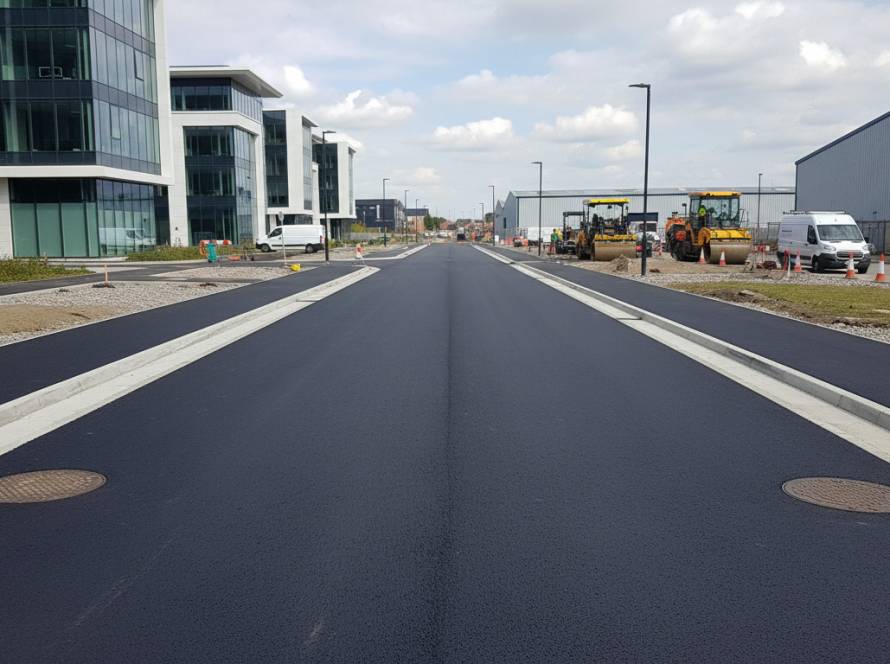
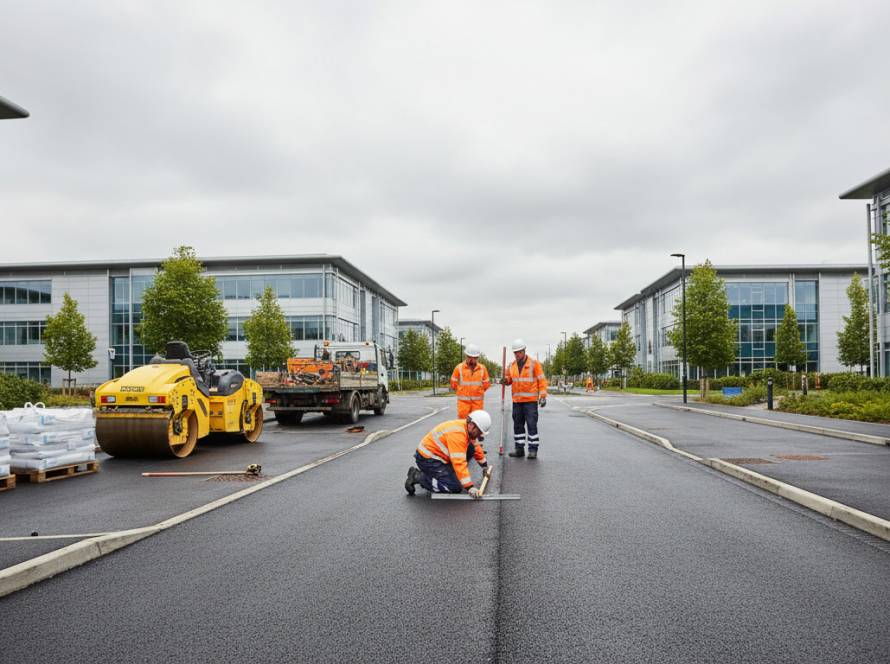
Supermarket car parks may appear to be relatively straightforward areas of hardstanding, but the demands placed on them are unusually varied. Throughout a normal trading day, the surface has to accommodate passenger vehicles, delivery lorries, refuse vehicles, trolley movements, pedestrians and frequent turning traffic. These different loads repeatedly affect the same parts of the car park, which is why similar patterns of deterioration can often be seen across supermarket sites.
The problem is rarely simply the number of vehicles using the site. Where those vehicles travel, stop, accelerate and turn can be considerably more important. Entrance lanes, junctions, delivery areas and parking aisles experience very different stresses despite forming part of the same car park.
For property owners and facilities managers, understanding these patterns can make maintenance and resurfacing decisions easier. Professional commercial surfacing and road surfacing should consider how each area will actually be used rather than treating the entire car park as though it experiences identical loading.
Repeated Vehicle Routes Concentrate Wear
Traffic inside a supermarket car park does not spread evenly across the available surface. Most drivers follow predictable routes from the entrance towards parking aisles before returning through similarly defined exit routes.
This creates concentrated traffic corridors. Some areas may receive thousands of vehicle movements while nearby parking spaces experience relatively little direct loading.
The difference becomes particularly noticeable at entrances and exits. Vehicles slow down, queue, accelerate and change direction in these locations. These actions introduce forces that are different from those created by a vehicle travelling steadily in a straight line.
Over time, the busiest routes can therefore show visible deterioration before quieter areas of the same surface. This does not necessarily mean that the entire car park has reached the end of its serviceable life. It may indicate that particular sections are experiencing substantially greater mechanical stress.
Turning Vehicles Place Additional Stress on the Surface
Turning movements are one of the major reasons supermarket car parks develop recognisable damage patterns. When a vehicle travels in a straight line, its tyres predominantly apply downward pressure. During a tight turn, however, the tyres also create sideways forces across the surface.
These forces can become particularly significant where larger vehicles are involved. Delivery lorries entering loading areas often need to make tight manoeuvres because of limited space. Their greater weight, combined with steering movement at low speeds, can place considerable stress on the surface layers.
Repeated turning in the same location may contribute to localised deformation, cracking or movement. Junctions between parking aisles can experience a similar effect because passenger vehicles repeatedly steer through approximately the same path.
Correct material selection and installation are therefore important in these high-stress areas. Professional tarmac installation and road surfacing services can take account of expected traffic movements when determining an appropriate construction for commercial sites.
Delivery Areas Face Different Loads from Customer Parking Spaces
One of the most important distinctions in supermarket car park surfacing UK projects is the difference between ordinary customer areas and sections used by heavy commercial vehicles.
A passenger car and a fully loaded delivery vehicle impose very different demands on a pavement structure. The heavier axle loads associated with commercial vehicles can place significantly greater stress on the surface and underlying construction.
Delivery routes may also be concentrated into relatively narrow areas behind or alongside the supermarket. Vehicles repeatedly approach the same loading bay, turn in similar positions and remain stationary while deliveries are completed.
These repeated loads can expose weaknesses that would remain unnoticed in a lightly trafficked parking area. Depressions, cracking or surface deformation near loading areas may therefore indicate that the pavement structure is struggling with the loads being imposed upon it.
This is why commercial surfacing should be designed around actual operational requirements. Applying exactly the same specification everywhere may not provide the most appropriate long-term solution when some areas carry considerably heavier traffic.
Water Often Reveals Existing Weaknesses
Water is another major factor behind recurring car park deterioration. A large supermarket car park represents a substantial impermeable area, meaning rainfall must be directed efficiently towards drainage points.
When drainage is inadequate, blocked or affected by surface deformation, standing water can begin appearing in predictable locations. These may include low points, channels alongside kerbs, areas surrounding gullies and depressions created by previous vehicle loading.
Standing water is more than an inconvenience for customers. Persistent moisture can enter cracks and weaknesses within the surface. Once water reaches lower pavement layers, the supporting structure can become more vulnerable to movement and deterioration.
Drainage and surfacing therefore need to work together. Simply replacing a visibly damaged surface without understanding why water collects in that location can result in the same problem eventually returning.
A proper assessment should consider gradients, drainage routes, existing channels and the condition of the underlying construction before deciding whether local repairs or more extensive resurfacing are appropriate.
Why Potholes Frequently Return to Similar Locations
Potholes are among the most obvious defects in any commercial car park. They can affect vehicle comfort, create trip hazards and make an otherwise well-maintained site appear neglected.
However, a pothole is usually the visible result of deterioration rather than the original cause.
Water may have entered through a crack, weakening the surrounding construction. Heavy vehicles may then repeatedly pass over the weakened section, gradually breaking away material until a hole becomes visible.
This explains why potholes can recur in the same areas if only the damaged surface material is replaced. Effective pothole repairs should consider the condition around and beneath the visible defect, particularly where there is evidence of water penetration or structural movement.
On supermarket sites, recurring potholes often appear along heavily trafficked routes, near drainage features and around delivery areas because these locations combine repeated loading with potential moisture-related deterioration.
Parking Bays Can Hide Wider Structural Problems
Parking bays usually experience less continuous traffic than circulation routes, but this does not mean they are immune to damage.
Vehicles remain stationary in these areas for longer periods, and drivers repeatedly steer while entering and leaving spaces. Some sections may also experience concentrated loading from larger vehicles or become affected by drainage problems.
Cracking within individual bays can sometimes appear relatively minor. However, where similar cracks occur across several neighbouring spaces, the pattern may indicate movement within the construction beneath the surface.
Surface appearance alone cannot always establish the cause. A crack may be limited to the upper layer, or it may reflect a deeper weakness in the pavement structure.
The distinction matters because the appropriate repair can be very different. Treating a superficial defect may require relatively limited work, while movement originating within the sub-base can require deeper reconstruction.
Poor Edge Support Creates Familiar Failure Patterns
The boundaries of a supermarket car park can also become vulnerable when the surface does not have adequate lateral support.
A well-constructed paved area depends partly on its edges remaining restrained. Kerbs and other edge details help prevent the pavement materials from spreading sideways under repeated loading.
Where edge support is damaged, poorly constructed or missing, cracking may begin close to the perimeter and gradually progress inwards. Vehicle loading close to an unsupported edge can accelerate this process.
These problems may occur near landscaped areas, access points, service roads or sections where kerbing has previously been disturbed.
Edge deterioration should therefore not automatically be treated as an isolated surface problem. Restoring appropriate restraint can be an important part of achieving a durable repair.
Utility Covers and Drainage Features Create Natural Weak Points
Supermarket car parks often contain numerous inspection covers, drainage gullies and other utility features. Each introduces an interruption into what would otherwise be a continuous pavement structure.
The surrounding material must be properly compacted and supported. If settlement occurs around a cover or gully, a small level difference can develop. Vehicle tyres then repeatedly strike or pass across that irregularity, increasing localised stress.
Cracking can subsequently form around the feature, allowing additional water penetration and accelerating deterioration.
This is one reason damage frequently appears as a ring or broken area surrounding utility covers rather than randomly across the surface.
Careful construction around these details is particularly important during resurfacing works. Machine-laid tarmac can help achieve consistent surfacing across larger areas, while utility features and restricted sections still require appropriate preparation, compaction and finishing.
Previous Repairs Can Become Future Failure Points
A supermarket car park that has operated for many years may contain numerous repairs from different periods. Some may have addressed potholes, drainage works, utility excavations or previous surface failures.
Every repair creates a joint between old and new materials. When correctly constructed, that joint can perform effectively, but it remains an area that should be considered during future inspections.
Movement, water penetration or inadequate sealing can cause deterioration along the boundary of an older repair. The result is often a distinctive rectangular or linear cracking pattern.
Repeated patching can eventually leave a surface made up of numerous repairs of different ages and conditions. At that stage, continuing to address individual defects may become less practical than considering wider resurfacing.
Reviewing examples of completed surfacing projects can also help property managers understand the difference between isolated repairs and broader resurfacing work.
Surface Damage Often Reflects Problems Below the Tarmac
One of the most important principles when assessing supermarket car park damage is that the visible surface is only part of the pavement construction.
Beneath the upper surfacing layers sits the supporting structure that distributes vehicle loads into the ground. If these lower layers are inadequate, poorly compacted or weakened by water, replacing only the top layer may not resolve the underlying problem.
This is particularly relevant where wheel-track depressions, repeated cracking or localised settlement continue to appear after previous repairs.
Before extensive resurfacing is undertaken, the existing construction should therefore be assessed carefully. Areas with sound underlying support may be suitable for surface renewal, while sections suffering deeper structural failure may require excavation and reconstruction.
The objective is not simply to make the car park look new. It is to provide a surface capable of handling the loading, drainage conditions and traffic movements expected during normal supermarket operations.
Why Maintenance Timing Matters
Car park defects generally become more expensive to address as deterioration progresses.
A small crack may initially represent a limited surface defect. Once water begins entering through it, however, surrounding materials can weaken. Repeated traffic then increases movement and enlarges the damaged area.
Early intervention can therefore prevent relatively minor problems from developing into more extensive failures.
Regular inspections are particularly useful after periods of heavy rainfall and during colder months, when existing weaknesses may become more visible. High-traffic sections, delivery routes, drainage points, patched areas and entrances deserve particular attention because these are often where deterioration develops first.
Maintenance decisions should be based on the condition and cause of the defect rather than appearance alone.
Planning Supermarket Car Park Surfacing Around Actual Site Use
The recurring nature of supermarket car park damage is useful from a maintenance perspective because predictable problems can be anticipated.
A thorough assessment can identify customer traffic routes, heavy vehicle movements, turning points, drainage paths, loading areas and existing weak sections. The surfacing specification can then respond to those conditions rather than assuming uniform usage across the entire site.
For larger commercial environments, experienced road surfacing services can consider these different requirements as part of the wider project planning process.
The same principle applies when organising resurfacing around an operational supermarket. Access often needs to remain available for customers, staff and deliveries, which may require works to be divided into carefully managed phases.
Understanding why damage has developed should come before deciding how much material needs replacing. Where the underlying cause is correctly identified, repairs can address more than the visible symptoms and provide a more durable outcome.
Supermarket car parks develop similar damage patterns because their traffic patterns are themselves repetitive. Vehicles follow the same circulation routes, delivery lorries use the same loading areas, drivers turn at the same junctions and rainwater follows the same gradients towards drainage points. Over time, those repeated stresses expose the parts of the pavement most vulnerable to deterioration.
Effective supermarket car park surfacing UK therefore depends on recognising how the site operates as a complete system. Traffic loading, drainage, ground preparation, edge support, existing repairs and underlying pavement condition all influence performance. When those factors are properly assessed, maintenance and resurfacing can be targeted at the causes of deterioration rather than repeatedly treating the same visible damage.