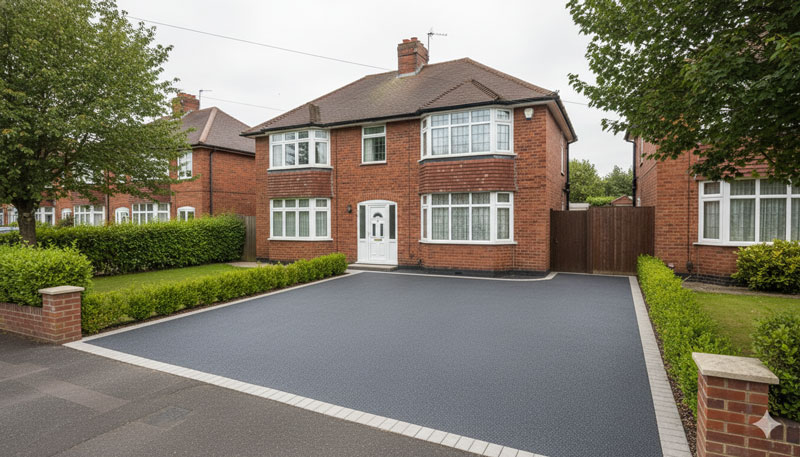
A new driveway can represent a significant investment, so choosing the lowest quotation can initially seem like a sensible way to control costs. If two surfaces appear similar when they are freshly completed, it is understandable for a property owner to wonder why they should pay more for one installation than another.
The real difference often becomes apparent later.
A driveway is not simply the visible layer of tarmac, asphalt or resin that vehicles travel across. Its long-term performance depends heavily on preparation, drainage, construction depth, material quality, compaction and the condition of the ground underneath. Reducing costs in these less visible areas can produce a driveway that looks perfectly acceptable when new but begins to deteriorate after repeated exposure to traffic and British winter weather.
This is why cheap driveway problems in the UK can become particularly noticeable after only a few winters. What initially appeared to be a saving can turn into repeated expenditure on patching, drainage improvements, crack repairs and eventually complete resurfacing.
The Cheapest Part of a Driveway Is Often the Part You Can See
When people compare driveway quotations, much of the attention naturally goes towards the finished appearance. A smooth black surface, neat edges and a clean entrance create an immediate impression of quality.
However, the visible surface tells only part of the story.
Much of the work responsible for driveway durability takes place before the final material is installed. Existing ground may need to be excavated, weak material removed, a suitable sub-base installed and compacted, levels established and drainage considered.
These stages require labour, machinery, aggregates and time. They are also areas where an unrealistically cheap installation can potentially reduce costs without the difference being obvious on completion day.
A professionally constructed tarmac driveway should therefore be considered as a complete construction rather than simply a layer of new material placed over the ground.
Poor Ground Preparation Creates Expensive Problems Later
The strength of a driveway begins beneath its finished surface.
If the ground is weak, poorly prepared or unsuitable for the expected vehicle loading, the upper layers cannot compensate indefinitely. Movement underneath the driveway can eventually cause settlement, depressions and cracking at the surface.
This is particularly important where an existing driveway has already failed.
Installing new surfacing directly over an unstable construction may temporarily hide the problem, but it does not necessarily remove its cause. If the underlying material continues to move, the new surface can begin to reflect the same defects.
Proper preparation may therefore increase the initial project cost while reducing the likelihood of premature repair work.
For property owners comparing quotations, differences in excavation and sub-base preparation can be more important than relatively small differences in the appearance of the finished material.
An Inadequate Sub-Base Can Shorten the Driveway’s Life
The sub-base distributes vehicle loads and provides a stable platform for the layers above it.
When this supporting layer is too thin, poorly compacted or constructed using unsuitable material, sections of the driveway can begin to move under traffic.
Initially, the signs may be subtle. A shallow wheel depression might develop where a vehicle is regularly parked. Water may begin collecting in an area that was previously level. Small cracks can appear around the edge of a settled section.
These defects can become progressively more serious.
Once the surface loses its intended profile, water has more opportunity to remain in depressions and penetrate weaknesses. Vehicle loading then continues to act on an already compromised construction.
Saving money on the supporting layers can therefore create a false economy. They may be largely invisible once the driveway is completed, but their condition influences almost everything happening above them.
British Winters Expose Weaknesses Quickly
UK driveways have to cope with repeated wet weather, low temperatures and occasional freezing conditions.
A well-constructed surface is designed with these conditions in mind. Problems arise when water can enter cracks, damaged edges or poorly constructed areas.
Water is particularly effective at revealing weaknesses because it does not need a large opening to begin causing problems. Once moisture reaches vulnerable sections of the construction, repeated traffic and weather cycles can accelerate deterioration.
Periods of freezing weather can make existing weaknesses more severe. Water that has entered cracks or voids can freeze and expand, placing additional pressure on the surrounding material.
A single cold period will not automatically destroy a driveway. The greater concern is repeated seasonal exposure acting on a surface that already contains construction weaknesses.
After two or three winters, the difference between a properly prepared driveway and one built primarily around the lowest possible initial price can become considerably more obvious.
Drainage Is One of the Worst Areas to Cut Costs
Water needs somewhere appropriate to go.
A driveway should normally be constructed with levels and falls that direct water towards suitable drainage arrangements rather than allowing it to remain across the surface or run towards buildings.
If levels are poorly planned, puddles may form after rainfall. At first, standing water can appear to be little more than an inconvenience. Over time, however, persistent moisture can contribute to surface deterioration and highlight areas of settlement.
Drainage problems can also be expensive to correct after a driveway has been installed.
Changing falls, installing additional channels or reconstructing low areas can involve disturbing a surface that might otherwise have remained intact. This means a relatively small saving during the original construction can result in significantly more disruptive work later.
Good drainage is therefore part of the driveway construction itself, not an optional finishing detail.
Thin Surfacing Can Struggle Under Regular Vehicle Loads
Another way to reduce an initial driveway price is to minimise the amount of material used.
The problem is that construction depth needs to be appropriate for the expected use of the driveway. A private driveway used by one or two cars experiences different loading from a commercial entrance regularly carrying vans or heavier vehicles.
Where the construction is inadequate for its traffic, deformation and deterioration can develop more quickly.
Repeated wheel movements tend to follow similar paths on driveways. Cars often enter, turn and park in almost exactly the same places every day. These concentrated loads can reveal weak areas surprisingly quickly.
The correct specification should therefore reflect how the driveway will actually be used rather than simply achieving the lowest cost per square metre.
Compaction Makes a Significant Difference
Tarmac and asphalt need to be properly laid and compacted.
Compaction helps create a dense, stable finished construction. If material is inadequately compacted, the driveway may contain areas that respond differently under vehicle loading and weather exposure.
Larger installations can benefit from appropriate machine-laid tarmac where site conditions allow, helping to achieve controlled and consistent material placement.
Regardless of the installation method, attention to temperature, laying conditions and compaction remains important.
These aspects are rarely what a property owner notices when viewing a newly completed driveway. They become important months and years later when assessing whether the surface has retained its shape and condition.
Weak Driveway Edges Can Start a Chain of Deterioration
Edges are particularly vulnerable because they do not always have the same surrounding support as the centre of the driveway.
Vehicles regularly driving close to an inadequately supported edge can cause cracking and movement. Once a small section begins breaking away, the damage can gradually progress further into the driveway.
Damaged edges can also provide an easier route for water to enter the construction.
A cheap installation that overlooks appropriate edge support may therefore develop problems even when the central surface initially remains in reasonable condition.
This is especially relevant for narrow driveways where drivers have little choice but to position their wheels close to the perimeter.
Small Cracks Rarely Become Smaller
A minor crack may not seem urgent, particularly if the rest of the driveway remains usable.
Unfortunately, cracks create opportunities for further deterioration. Water can enter them, traffic can place repeated stress around them, and seasonal temperature changes can cause them to widen.
The result can be a gradual transition from a cosmetic defect into a structural maintenance issue.
The same principle applies to small areas of surface breakdown. Once material becomes loose, passing tyres can disturb the surrounding edges and increase the damaged area.
Early maintenance is generally preferable to waiting until a defect has expanded. Where deterioration has progressed into deeper localised damage, professional pothole repairs may be necessary to restore the affected area.
Repeated Patching Can Cost More Than Doing the Job Properly Once
One of the biggest financial problems with a poorly constructed driveway is that the owner rarely receives one large repair bill immediately.
Instead, expenditure can arrive gradually.
A crack may be repaired during the first year. A sunken section might require attention after another winter. Drainage may then need improvement, followed by patching around an entrance or parking area.
Each individual repair can appear manageable. Taken together over several years, however, the total can substantially reduce or eliminate the saving achieved by choosing the cheapest original installation.
There is also disruption to consider. Repeated repair visits mean areas may need to be cleared, vehicle access restricted and normal use temporarily changed.
A durable driveway should reduce the frequency with which these interventions are necessary.
Cheap Resurfacing Can Hide an Expensive Structural Problem
There is an important distinction between surface deterioration and structural failure.
If an existing driveway has simply become worn while its supporting construction remains sound, resurfacing may be an appropriate solution.
If the driveway is failing because the ground or sub-base underneath is unstable, adding a fresh surface does not automatically correct the underlying issue.
This is where an unusually low resurfacing price should be considered carefully.
Covering cracks and depressions can make a driveway look dramatically better immediately after completion. If the movement underneath remains unresolved, however, defects may eventually reappear through the new surface.
An assessment of the existing construction should therefore come before deciding how much work is actually necessary.
Resin Driveways Still Depend on Proper Preparation
Choosing a different surface material does not remove the need for a stable foundation.
A professionally installed resin driveway can provide a clean and attractive finish, but its performance still depends on the suitability and stability of the construction beneath it.
The same principle applies across driveway types: the finished surface cannot indefinitely compensate for serious movement underneath.
Property owners comparing surfacing options should therefore consider preparation and existing ground conditions alongside colour, texture and initial installation cost.
A Low Quote Is Not Automatically a Bad Quote
Price alone does not determine quality.
An efficient contractor with suitable machinery, good planning and straightforward site access may legitimately provide a competitive quotation. Equally, a more expensive quotation does not guarantee that every element of the installation is appropriate.
The important issue is what the quotation actually covers.
Preparation depth, removal of unsuitable material, sub-base construction, drainage arrangements, edge details, surfacing specification and access requirements can all influence the final cost.
Two contractors may therefore appear to be quoting for the same driveway while proposing substantially different levels of work.
Understanding those differences is more useful than comparing the final figures in isolation.
Think in Terms of Cost Per Year, Not Just Installation Price
A driveway is a long-term part of a property.
For that reason, the cheapest installation price does not necessarily represent the lowest overall cost.
A properly designed and constructed driveway that performs reliably for many years may provide better value than a cheaper alternative requiring frequent intervention. Maintenance will eventually be necessary for most external surfaces, but premature structural repairs should not be treated as normal simply because a driveway has experienced a few British winters.
Property owners can view examples of completed surfacing projects to understand how different sites and applications can require different approaches.
The most useful question is therefore not simply, “How cheaply can this driveway be installed?” It is, “What construction is needed for this driveway to perform properly under the conditions it will actually face?”
When preparation, drainage, materials, compaction and expected traffic are considered from the beginning, the initial quotation may not always be the lowest. What it can provide is a stronger foundation for predictable long-term performance and a reduced risk of discovering, several winters later, that the cheapest driveway has become the most expensive one to own.