An uneven driveway is more than an appearance issue. Changes in the surface can affect drainage, vehicle access, pedestrian safety and the overall condition of the surrounding property. Small dips and raised areas may initially seem minor, but they can gradually become more noticeable as vehicles repeatedly travel across the surface and changing weather conditions affect the layers underneath.
The causes of uneven driveways vary considerably. In some cases, the problem begins beneath the finished surface because the ground or sub-base was not prepared correctly. In others, drainage problems, repeated loading, poor compaction or deterioration of the surfacing material can cause the driveway to lose its original profile.
Understanding why a driveway has become uneven is important before deciding how it should be repaired. Simply covering an existing problem with another layer of material will not necessarily provide a lasting solution if movement is continuing underneath.
Professional tarmac installation and road surfacing services therefore depend heavily on preparation, drainage and appropriate material selection rather than focusing solely on the visible surface.
Poor Ground Preparation
Ground preparation is one of the most important factors affecting the long-term stability of a driveway. A finished surface relies on the layers beneath it to provide consistent support.
If unsuitable material remains beneath the driveway, or the formation is not properly prepared before the sub-base is installed, certain areas may settle more than others. This differential movement can create dips, depressions and irregular sections across the finished driveway.
The problem may not become visible immediately. A newly installed surface can initially appear smooth because the upper layer has been laid evenly. As vehicles begin using the driveway and the underlying ground experiences repeated loading, weaker areas can gradually compress.
Seasonal moisture changes can make the situation worse. Ground that becomes saturated can lose some of its supporting strength, particularly where drainage is inadequate. Once the underlying layers move, the surface above will usually follow.
This is why preparation should be considered part of the driveway itself rather than simply a preliminary stage of construction.
An Inadequate or Poorly Constructed Sub-Base
The sub-base distributes loads from vehicles across the ground below. If it is too thin, inconsistent or constructed from unsuitable material, the driveway may not receive uniform support.
An uneven sub-base can result in the finished surface being stronger in some locations than others. Areas regularly crossed by vehicle wheels may then begin to sink, creating visible wheel tracks or shallow depressions.
Why Sub-Base Depth Matters
The appropriate construction depth depends on factors including the existing ground conditions, expected vehicle loading and the intended use of the driveway. A domestic driveway used by ordinary cars will experience different loading from an access area regularly used by vans, delivery vehicles or heavier commercial traffic.
Increasing the quality of the visible surface cannot compensate indefinitely for inadequate support beneath it. Even durable surfacing materials can deform or crack when the underlying construction is unstable.
Correct assessment before installation is therefore essential. Experienced surfacing services should consider the complete construction rather than treating the wearing course as an isolated layer.
Insufficient Compaction
Compaction helps create a stable and consistent foundation. Aggregate placed within a driveway construction contains spaces between individual particles. Proper compaction reduces those spaces and helps the material form a dense supporting layer.
When compaction is inconsistent, loose areas can remain within the construction. These areas may subsequently compress under traffic, causing localised settlement.
This can produce an uneven surface even when good-quality materials have been used.
Compaction is required at appropriate stages of construction rather than only after the final material has been placed. The underlying layers need to provide a firm platform before surfacing begins. For larger areas, professional machine-laid tarmac can help achieve a controlled finish, but the quality of the foundation remains fundamental to the final result.
Poor Drainage and Standing Water
Water is one of the most significant contributors to driveway deterioration.
A driveway should be designed so rainfall moves away from the surface efficiently. Depending on the property and construction, this may involve carefully formed falls, drainage channels or other suitable drainage arrangements.
When water repeatedly collects in depressions, it can accelerate deterioration. Existing low spots may hold more water, while deterioration caused by that moisture can make those low areas progressively worse.
Water Beneath the Surface
Visible standing water is only one part of the issue. Water entering cracks, damaged edges or poorly drained surrounding ground can also affect the construction beneath the surface.
If the supporting layers become saturated or material is displaced, localised settlement can develop. Over time, this may appear as sinking areas, cracking or deformation.
Drainage problems are particularly important because repairing only the surface may provide limited benefit if the source of the water remains unchanged. The drainage conditions should therefore be assessed alongside the damaged area.
Repeated Vehicle Loading
Every driveway experiences loading when vehicles travel across it, but the amount and type of loading can differ substantially between properties.
A surface designed primarily for cars may deteriorate more quickly if it begins receiving frequent deliveries from heavier vehicles. Vans, skips, construction traffic and other substantial loads place greater pressure on the pavement construction.
The effects are often concentrated along common wheel paths. Repeated loading in the same locations can expose weaknesses in the sub-base or underlying ground, eventually creating depressions.
Turning movements can also place additional stress on the surface. Vehicles that regularly turn their wheels while stationary or manoeuvre tightly in the same area can increase wear.
For properties that experience heavier or more frequent traffic, construction principles associated with commercial surfacing and road surfacing may be relevant because loading requirements need to be considered from the beginning.
Tree Roots and Nearby Vegetation
Trees and established vegetation can sometimes contribute to uneven driveway surfaces.
As roots grow beneath or close to a driveway, they can influence the surrounding ground. In some circumstances, root growth can cause localised lifting. Changes in soil moisture associated with nearby vegetation can also contribute to ground movement depending on the site conditions.
The visible result may be a raised section, cracking or gradual distortion.
Root-related problems require careful assessment because removing or cutting roots without considering the health and stability of the tree may create additional issues. Where significant trees are involved, specialist advice may be appropriate before surfacing repairs are undertaken.
The important point is that a raised driveway is not always caused by the surfacing material itself. The source of movement can be below or alongside the driveway.
Weak or Deteriorating Driveway Edges
The edges of a driveway can be particularly vulnerable because they do not always receive the same lateral support as material within the centre of the surface.
If edge support is inadequate, repeated vehicle loading near the perimeter can cause cracking, spreading or gradual deformation. This is particularly common where vehicles frequently drive partly onto the edge while entering or leaving the property.
Once the edge begins to fail, water can penetrate the damaged area and further weaken the construction.
Edge deterioration can then progress towards the centre of the driveway. What begins as a relatively small damaged section can eventually affect a much larger area if the underlying cause is not addressed.
Previous Repairs That Have Settled
Older driveways often contain sections that have previously been excavated and repaired. Utility work, drainage installation and localised surface repairs can all involve removing part of the existing construction.
If replacement material is not installed and compacted correctly, the repaired area may subsequently settle.
This can leave a noticeable depression that follows the shape of the previous excavation. Differences between the original construction and repaired section can also create joints where water begins to penetrate.
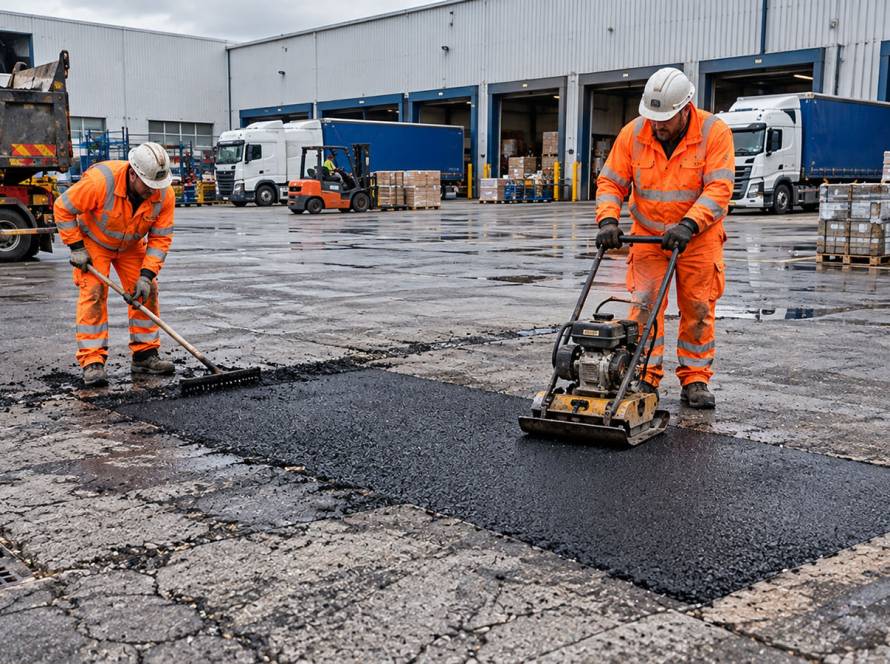
Local repairs can be entirely appropriate when deterioration is confined to a specific area, but the repair needs to address the failed material properly. Professional pothole repairs and localised surfacing work should restore stable support rather than simply filling the visible depression.
Age and General Surface Deterioration
Even a correctly installed driveway will experience wear over time.
Traffic, rainfall, temperature changes and general use gradually affect the surface. Small cracks can develop and allow moisture into lower layers. Edges can deteriorate, previous repairs may become visible and minor imperfections can increase.
The condition should therefore be assessed as a whole.
A few isolated defects may be suitable for local repair, whereas widespread deformation can indicate that the construction has reached a stage where more substantial resurfacing work is appropriate.
Examples of completed surfacing projects can also help property owners understand how different access areas and driveway surfaces can be approached depending on their condition and intended use.
Why Simply Resurfacing an Uneven Driveway May Not Work
Placing a new surface over an uneven driveway can appear to provide an immediate improvement. However, the long-term result depends on why the existing driveway became uneven.
If the original problem was caused by poor ground conditions, inadequate compaction, failed drainage or an unstable sub-base, those issues can continue beneath the new material.
The same depressions or cracks may eventually return.
Identifying Structural and Surface Problems
A surface defect is generally confined to the upper part of the driveway construction, while a structural problem involves the supporting layers beneath it. Distinguishing between the two is important when determining an appropriate repair.
Minor deterioration in an otherwise stable driveway may require relatively limited intervention. Significant settlement, widespread deformation or repeated failure in the same location can indicate that deeper investigation is required.
The correct solution therefore depends on condition rather than appearance alone.
Preventing Uneven Driveways Through Correct Installation
Preventing unevenness begins before the finished driveway surface is installed.
The existing ground needs to be assessed and unsuitable material dealt with appropriately. The sub-base then needs to provide sufficient support for the expected traffic and must be compacted consistently.
Drainage should also be considered during the design stage. Creating appropriate falls and controlling where water travels can reduce the risk of standing water and moisture-related deterioration.
The surfacing material must then be installed to an appropriate standard and thickness for the intended use.
For some residential properties, alternative finishes such as resin driveways may be considered where suitable, while tarmac remains a practical option for many driveways and access areas. Whichever surface is selected, its performance will remain closely connected to the quality of the construction underneath.
Assessing an Existing Uneven Driveway
When a driveway starts to become uneven, the most useful first step is identifying the pattern of movement.
A single depression may indicate a local weakness or previous excavation. Repeated wheel-track settlement can suggest loading or sub-base problems. Raised sections may point towards ground movement or vegetation, while standing water can reveal insufficient falls or developing depressions.
Cracking can provide further information because it often shows where movement is taking place.
A professional assessment should consider these symptoms together rather than treating each visible defect independently. The aim is to establish whether the problem is limited to the surface or originates deeper within the construction.
Once the cause has been identified, an appropriate repair can be selected. That might involve localised work where the surrounding construction remains sound, or more extensive reconstruction where the foundation has failed.
A properly constructed driveway depends on several elements working together. Stable ground, an appropriate sub-base, consistent compaction, effective drainage and suitable surfacing all contribute to maintaining an even finish. Addressing the underlying cause of deformation, rather than simply covering the visible symptoms, provides the strongest basis for restoring reliable vehicle access and achieving better long-term surface performance.