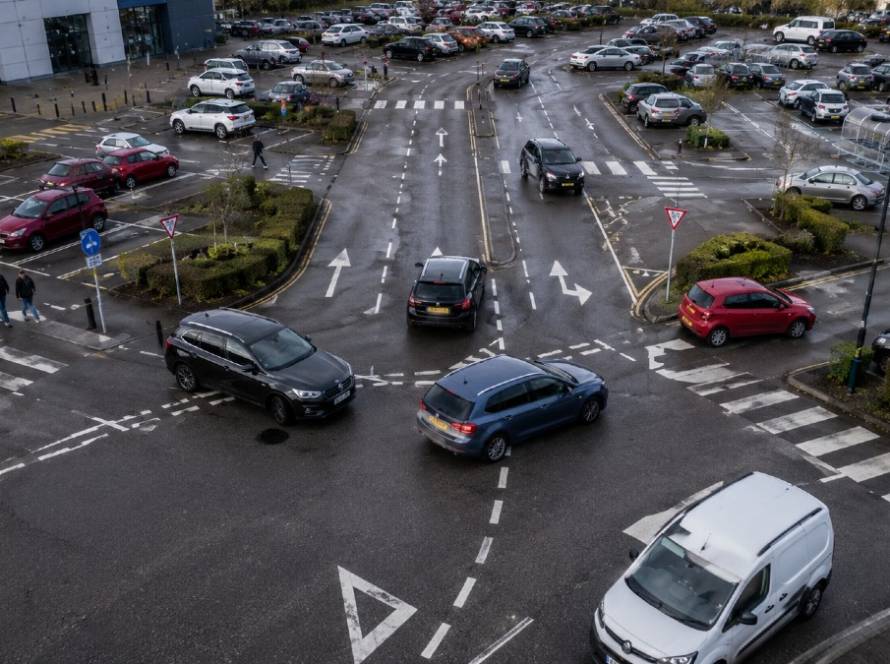
A smooth, level car park might appear to be the ideal result of a surfacing project. To a property owner, facilities manager or commercial site operator, a perfectly flat finish can suggest careful workmanship and a high-quality installation. However, when it comes to external surfacing, completely flat is not necessarily desirable.
Car parks are exposed to rainfall throughout the year, and the surface needs to manage that water effectively. A carefully designed car park will normally incorporate subtle gradients that direct water towards drainage channels, gullies or other suitable collection points. These falls can be difficult to notice when walking or driving across the site, but they play an important part in protecting the surface and keeping the car park usable.
A car park that is genuinely flat, with no effective falls or drainage strategy, may therefore indicate a problem rather than exceptionally precise workmanship.
Why Car Parks Need More Than a Smooth Surface
The visible surface is only one part of a properly constructed car park. Beneath it, the condition and preparation of the underlying layers influence how effectively the finished area performs under traffic and changing weather conditions.
Professional commercial surfacing and road surfacing needs to consider vehicle movements, expected loads, drainage, levels and the existing ground. These factors influence decisions made before the final surface course is installed.
The objective is not simply to create an area that looks smooth. It is to create a surface that remains stable, practical and capable of dealing with water.
This distinction is particularly important on large commercial car parks. Even a shallow depression or an incorrectly established level can collect a substantial quantity of rainwater because water is being gathered from a much wider surrounding area.
A Small Gradient Can Make a Significant Difference
A properly surfaced car park can look almost completely level while actually incorporating carefully controlled falls. These slight gradients allow gravity to move rainwater away from parking bays and vehicle routes towards designated drainage points.
The gradients do not usually need to be visually obvious. In fact, excessively steep or inconsistent gradients can create their own problems for vehicles and pedestrians. The aim is controlled water movement rather than a noticeably sloping car park.
This is one reason experienced surfacing contractors pay close attention to levels during preparation and installation. The finished appearance should be considered alongside how the surface will perform during wet weather.
Where large areas are being surfaced, machine lay tarmac can help achieve a consistent finish across substantial areas. However, consistency does not mean removing every planned change in level. The surface still needs to follow the designed profile so water can travel in the intended direction.
What Happens When Water Has Nowhere to Go?
When a car park has insufficient falls, rainfall may remain on the surface rather than moving towards drainage infrastructure. The most immediate result is usually standing water.
A small puddle after an intense period of rainfall does not automatically indicate that an entire car park has been constructed incorrectly. The concern is persistent or repeated ponding, particularly where water consistently gathers in the same locations after ordinary rainfall.
Standing water can make a commercial site less convenient to use. Drivers may have to pass through pooled water, pedestrians may need to walk around it, and entrances or pedestrian routes can become unnecessarily wet.
During colder weather, retained surface water can also become a safety concern if temperatures fall sufficiently for freezing to occur. Effective drainage therefore contributes not only to surface performance but also to the practical management of the site.
Water Can Reveal Problems With the Surface Profile
Dry weather can disguise level problems surprisingly well. A newly laid surface may appear uniform when viewed across a car park, particularly when the tarmac has a consistent colour and texture.
Rainfall effectively tests the surface profile.
Water naturally moves towards low points. If it travels cleanly towards gullies or drainage channels, the designed falls are doing their job. If it collects in isolated areas away from drainage points, this can reveal depressions or inconsistencies that were difficult to see when the surface was dry.
For property and site managers assessing existing surfacing, looking at a car park shortly after rainfall can therefore provide useful information. Patterns of standing water can help identify where drainage performance or surface levels may require closer investigation.
Why Ground Preparation Matters
The finished levels of a car park are influenced by what happens before the final tarmac layers are installed. Proper preparation creates the foundation upon which the finished profile is formed.
If underlying levels are incorrect, attempting to compensate entirely within the final surface can be problematic. Preparation should account for the intended drainage direction, existing structures, kerbs, entrances, drainage channels and surrounding ground.
Professional tarmac installation and road surfacing therefore involves much more than simply applying material over an existing area. The condition and profile of the base need to support the finished surface and the traffic expected to use it.
A visually impressive surface cannot compensate indefinitely for unsuitable preparation underneath it.
Existing Levels Can Complicate Car Park Resurfacing
Resurfacing an existing car park can present different challenges from constructing a new one. Existing kerbs, buildings, drainage points, access roads and thresholds may restrict how much the finished levels can be changed.
This makes an initial assessment particularly important. Contractors need to understand where water currently travels, where it collects and how proposed surfacing works could affect those patterns.
Simply covering an existing problem with another layer of material does not necessarily solve it. If the underlying profile continues to direct water towards a low point, the drainage issue may remain after resurfacing.
The correct approach depends on the condition and construction of the existing area, which is why each site needs to be assessed individually.
Why Drainage Should Be Planned With the Surfacing
Drainage and surfacing should not be treated as completely separate parts of a car park project. The two systems need to work together.
A drainage channel is only useful if water can reach it. Similarly, carefully constructed falls cannot remove water effectively if they direct rainfall towards an unsuitable location.
The relationship between surface levels and drainage points is therefore fundamental. Before surfacing begins, the contractor needs to understand where water should travel and how the finished profile will encourage that movement.
This is especially important on commercial sites where different areas may connect. A car park may meet an access road, loading area, pedestrian route or building entrance. Altering levels in one location can potentially influence water movement elsewhere.
For site managers considering wider improvements, reviewing the available surfacing services alongside the condition of existing drainage can help provide a clearer understanding of what a project may involve.
Flatness and Smoothness Are Not the Same Thing
One of the most important distinctions is between a surface being smooth and a surface being completely flat.
A smooth car park is generally desirable. Vehicles should be able to travel across it comfortably, and the surface should not contain unnecessary bumps, abrupt level changes or poorly finished joints.
A completely flat surface is different. If there is no meaningful gradient, gravity has little opportunity to move water towards drainage points.
A well-constructed car park can therefore be smooth without being mathematically level. The subtle variation in height across the area is deliberate and functional.
This is why judging workmanship solely by whether a surface appears perfectly flat can be misleading. The better question is whether the levels are appropriate for the site and whether water moves as intended.
Vehicle Loading Also Influences Long-Term Levels
Even where a car park has been constructed with suitable falls, its profile needs to remain stable under use.
Commercial car parks can experience repeated vehicle loading every day. Some sites also accommodate delivery vans, refuse vehicles or heavier commercial traffic. The construction beneath the visible surface needs to be appropriate for those demands.
If underlying layers move or deform, localised depressions can develop. These areas may then begin holding water even though the original drainage design was suitable.
Repeated loading is particularly relevant around entrances, turning areas and locations where vehicles regularly brake or manoeuvre. These parts of a site can experience different stresses from straightforward parking bays.
Good construction therefore combines suitable surface levels with an adequately prepared and compacted foundation.
Persistent Puddles Should Not Simply Be Ignored
Once standing water becomes familiar, it can be easy to treat it as an unavoidable characteristic of an older car park. However, persistent ponding is worth investigating because it provides information about how the surface is performing.
The appropriate solution will depend on the cause. In some cases, local deterioration may require targeted pothole repairs. In others, the issue may involve a broader problem with surface levels, drainage or the condition of the underlying construction.
Repairing only the visible symptom without understanding why water is collecting may provide limited long-term benefit. If the same low point remains, water can continue returning to that location.
A professional assessment can help establish whether the problem is isolated or whether more extensive surfacing work should be considered.
What Site Managers Should Look for After Rainfall
Wet weather provides an opportunity to observe a car park under conditions that reveal how its drainage is actually functioning.
Rather than concentrating solely on whether puddles exist immediately after heavy rain, it is useful to consider where water is moving. Water should generally be travelling towards intended collection points rather than sitting unpredictably across vehicle and pedestrian areas.
Repeated ponding in the same locations deserves attention, particularly where it affects entrances, parking bays, walkways or heavily trafficked areas.
The condition around drainage channels and gullies also matters. A correctly profiled surface cannot perform properly if drainage infrastructure is blocked or unable to accept the volume of water reaching it.
Looking at the whole system gives a more useful picture than assessing the tarmac in isolation.
Good Car Park Surfacing Is Designed to Perform
A high-quality car park should certainly look neat and consistent, but appearance is only part of the result. Surface levels, drainage, preparation and construction all contribute to long-term performance.
The best gradients may be almost invisible during normal use. Drivers may never notice that one side of a parking area sits slightly lower than another, yet that subtle difference can determine where thousands of litres of rainfall travel over the life of the surface.
For property owners and commercial site managers, this changes what a successful finish looks like. Perfect visual flatness should not automatically be considered a mark of quality. What matters is whether the surface has been designed and constructed around the practical conditions of the site.
Examples of completed surfacing projects can also help demonstrate how professional surfacing needs to balance appearance with practical requirements.
Ultimately, a car park should be smooth, stable and appropriately graded rather than simply flat. When rainfall arrives, those carefully established levels become an essential part of the surface, quietly directing water away from the areas where vehicles and pedestrians need to move safely.