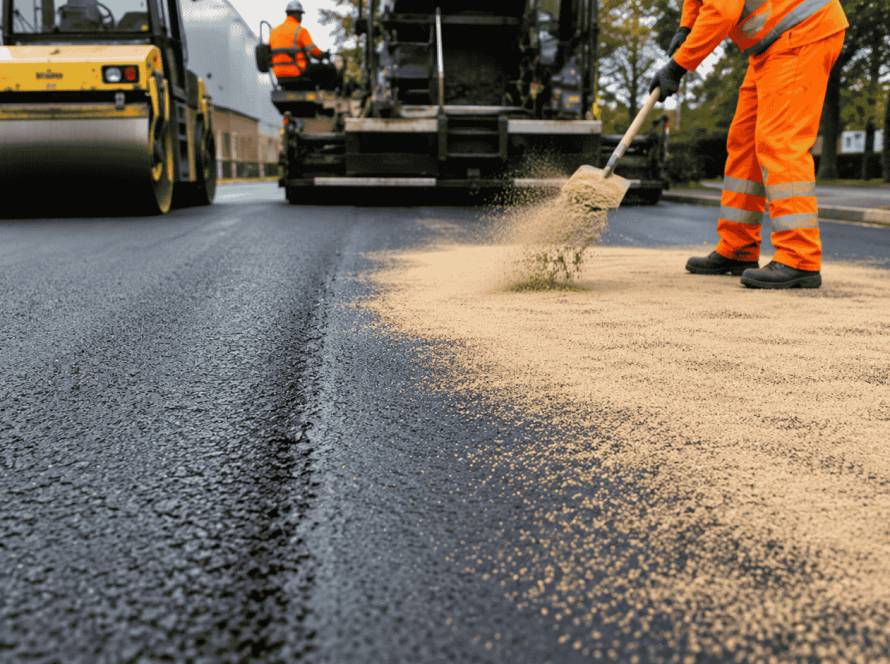
Small patches of loose aggregate on a road can seem relatively minor when they first appear. A few loose stones or a slightly rough area may not immediately affect access, but these changes can indicate that the surface material is beginning to deteriorate. For property owners and commercial site managers, recognising the problem early can make it easier to manage repairs before a small affected area develops into a more substantial defect.
Aggregate is an important part of asphalt and tarmac road construction. The stone material combines with a bituminous binder to create a compact, durable surface capable of supporting regular traffic. When the bond between these materials begins to weaken, individual pieces of aggregate can become detached.
This process is commonly associated with surface fretting or ravelling. Instead of remaining tightly bound within the road surface, stones begin working loose under vehicle tyres and environmental exposure. The affected area can gradually become rougher as additional material is lost.
The presence of loose aggregate does not automatically mean that an entire road needs resurfacing. The appropriate response depends on why the material is becoming loose, how extensive the deterioration is and whether the underlying construction remains stable.
What Causes Loose Aggregate on Road Surfaces?
There is rarely one universal cause of loose aggregate. Roads operate under changing conditions throughout the year, and deterioration can result from a combination of traffic, water, age and construction-related factors.
Understanding the underlying cause is particularly important before repairs are undertaken. Simply covering a damaged area without dealing with the reason it failed can result in the same problem returning.
Ageing of the Road Surface
Road surfacing materials naturally change as they age. The bituminous binder that helps hold the aggregate together can gradually become harder and less flexible after prolonged exposure to weather and traffic.
Once the binder becomes less effective, the surface may begin releasing individual stones. Initially, this can appear as isolated patches rather than deterioration across the whole road.
Older private roads, commercial access routes and service areas may therefore develop localised aggregate loss even when much of the surrounding surface still appears serviceable.
The rate at which this happens depends on the original construction, traffic levels, drainage conditions and ongoing maintenance.
Inadequate Compaction
Compaction is a fundamental part of creating a durable road surface. Surfacing material needs to be properly consolidated during installation so that the aggregate forms a dense and stable structure.
If an area receives insufficient compaction, the material may contain more voids than intended. This can reduce its resistance to traffic movement and water penetration.
Problems may not become obvious immediately after construction. Repeated vehicle movements can gradually expose weaker sections, eventually resulting in aggregate becoming loose.
Professional tarmac installation therefore involves more than simply placing surfacing material. Preparation, laying conditions and effective compaction all contribute to the finished road’s long-term performance.
How Water Contributes to Aggregate Loss
Water is one of the most important factors affecting the condition of road surfaces.
A properly constructed road should be designed to move surface water away efficiently. However, cracks, depressions, damaged edges or drainage problems can allow moisture to remain on or enter the road construction.
Once water reaches vulnerable areas, it can contribute to deterioration around the aggregate and binder.
Repeated wetting, combined with vehicle loading, can progressively weaken an already compromised surface. Traffic then places additional mechanical stress on the affected material.
This is why a patch of loose aggregate should be considered alongside the drainage conditions around it. If water regularly collects in the same location, repairing only the visible surface may not provide a lasting solution.
Standing Water and Poor Drainage
Standing water is particularly relevant where roads contain depressions or have inadequate falls.
Commercial yards, private access roads and older parking areas sometimes change shape gradually under repeated traffic loading. Small depressions can form, allowing rainwater to remain on the surface longer than intended.
Drainage channels can also become blocked or damaged, changing the route that water takes across the site.
Where loose aggregate repeatedly develops in a wet area, drainage should form part of the assessment rather than being treated as an unrelated issue.
The Effect of Traffic on Loose Aggregate
Vehicle tyres apply both downward and horizontal forces to a road.
On a sound surface, the construction is designed to withstand these forces. Once aggregate begins loosening, however, repeated traffic can accelerate the deterioration.
Turning movements can be particularly demanding because tyres place additional lateral stress on the surface. This can make entrances, junctions, turning areas, loading zones and parking manoeuvring areas more susceptible to visible wear.
Heavy commercial vehicles introduce further loads. A road carrying delivery vehicles or HGVs regularly has different performance requirements from a lightly used residential access road.
For these environments, properly designed commercial road surfacing needs to take expected traffic conditions into account rather than treating every road as having identical requirements.
Is Loose Aggregate Dangerous?
A very small amount of loose aggregate does not necessarily create an immediate major hazard, but it should not automatically be ignored.
Loose stones can reduce the consistency of the road surface. For vehicles, particularly motorcycles and bicycles, significant quantities of loose material may affect available grip. Pedestrians can also find loose or uneven areas less comfortable to walk across.
The larger concern is often what the loose aggregate indicates about the road itself.
If aggregate continues separating from the surface, the affected area loses material and becomes progressively rougher. This can create an increasingly vulnerable section of road.
The condition should therefore be monitored and assessed according to its location, extent and rate of deterioration.
Can Loose Aggregate Develop Into a Pothole?
Localised surface deterioration can progress if the underlying cause remains unresolved.
Once material has been lost, the affected area may become more vulnerable to water and traffic. Additional aggregate can then loosen around the edges, gradually increasing the size of the defect.
As deterioration moves deeper into the surface, a depression can develop. Continued traffic removes weakened material, potentially creating the conditions associated with pothole formation.
Not every patch of loose aggregate will become a pothole. Nevertheless, early deterioration is generally easier to manage than a deeper defect involving multiple layers of the road construction.
Where deterioration has already become more substantial, professional pothole repairs can be used to remove compromised material and reinstate the affected area appropriately.
When Is a Localised Repair Appropriate?
Small, clearly defined areas of damage may sometimes be suitable for localised repair.
The existing material surrounding the defect needs to be sufficiently sound for the repair to perform properly. The affected material can then be dealt with and the area reinstated using an appropriate surfacing system.
The precise repair method depends on the condition of the existing road and the depth of the deterioration.
A local repair becomes less appropriate when loose aggregate is appearing across numerous sections of the road. Multiple defects can suggest broader ageing, inadequate construction or widespread surface deterioration.
In those circumstances, repeatedly repairing individual patches may address the symptoms without resolving the overall condition of the road.
When Should Resurfacing Be Considered?
Resurfacing becomes more relevant when deterioration is widespread or when the existing surface has reached a condition where isolated repairs are no longer practical.
The road should be considered as a complete construction rather than simply looking at the visible top layer. A new surface placed over an unstable base will still depend on the condition of the material underneath it.
Professional road surfacing services can therefore involve assessing existing conditions, preparation requirements and the intended use of the road before deciding how the surface should be reinstated.
For larger areas where consistent placement is required, machine-laid tarmac can provide controlled installation across suitable commercial roads and access areas.
The appropriate method depends on site access, road dimensions, existing construction and anticipated traffic.
Why the Underlying Road Construction Matters
Visible aggregate loss occurs at the surface, but the condition underneath should not be overlooked.
Road construction generally relies on several layers working together. The upper surfacing layer provides the running surface, while the layers beneath it distribute loads and provide structural support.
If the underlying construction moves excessively, the surface above can experience additional stresses.
Poorly prepared ground, inadequate sub-base material or insufficient compaction can contribute to movement. Water entering the construction can make existing weaknesses more significant.
This means two roads showing apparently similar patches of loose aggregate may require different solutions. One may have relatively superficial wear, while another may be showing the first visible signs of a deeper structural problem.
Why Early Inspection Is Useful
One of the advantages of identifying loose aggregate early is that the condition can be assessed before substantial material is lost.
Site managers can observe whether the affected patch is stable or becoming larger. Changes after periods of heavy rain or increased vehicle use can also provide useful information about what is contributing to deterioration.
The surrounding area should be considered at the same time. Cracking, depressions, damaged edges, standing water and nearby drainage problems can all provide context.
An experienced surfacing contractor can assess whether deterioration appears localised or whether a wider section of the road requires attention. Total Surfacing provides a range of surfacing services covering different road, access and property requirements.
Preventing Further Surface Deterioration
The long-term performance of a road depends heavily on appropriate construction and maintenance.
Good ground preparation establishes a stable foundation. Suitable materials provide the required strength, while correct laying and compaction create a dense surface capable of resisting traffic. Effective drainage helps prevent unnecessary water exposure.
Traffic requirements also need to be considered from the beginning. A lightly trafficked private road and a busy commercial access route place very different demands on their surfaces.
Once a road is in service, periodic inspection can help identify early changes. Small patches of aggregate loss, cracks and drainage problems are easier to investigate when they remain localised.
Ignoring deterioration until the road contains deep potholes or widespread failure can increase the amount of work required to restore a reliable surface.
Assessing Small Patches of Loose Aggregate on a Road
Small patches of loose aggregate should be viewed as an indication that something within the surface has changed.
In some situations, the issue may be limited to an ageing or locally weakened section of surfacing. In others, aggregate loss can be associated with water penetration, insufficient compaction, heavy traffic or deterioration beneath the visible surface.
The extent of the problem is therefore more important than the presence of a few loose stones alone.
A suitable assessment considers the size and depth of the affected area, the condition of the surrounding surface, drainage, traffic loading and the stability of the construction underneath.
Where deterioration remains localised, targeted repairs may be sufficient. Where the same symptoms occur repeatedly or across larger areas, more extensive resurfacing may provide a more appropriate long-term approach.
Addressing the cause as well as the visible damage is ultimately what helps protect the road from continuing deterioration and maintains a safer, more consistent surface for vehicles and pedestrians.