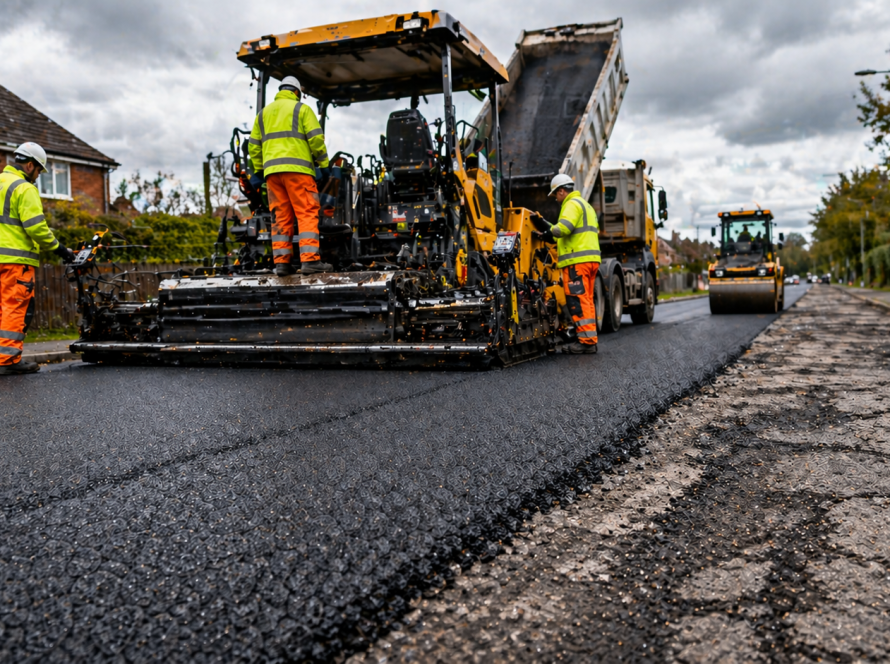
A newly finished driveway naturally draws attention to what can be seen. The smooth tarmac, clean edges, consistent colour and tidy connection to the pavement or garage are the parts that determine the immediate appearance of the project. Yet these visible elements are only the final layer of a much larger construction process.
In many cases, the most important investment is underneath the finished driveway.
Excavation, sub-base construction, compaction, drainage preparation and ground stabilisation can represent a substantial part of the work involved in building a driveway properly. Once the surface has been installed, however, virtually all of this disappears from view.
That can make driveway quotations difficult for property owners to compare. Two contractors may appear to be offering a similar finished driveway, but the specification beneath the surface can be very different. Understanding professional driveway ground preparation UK requirements therefore helps explain why the cheapest initial quotation does not always represent the lowest long-term cost.
A Driveway Is a Layered Construction
A driveway should not be thought of simply as a layer of tarmac or another surfacing material placed over the ground. It is a structure designed to transfer the weight of vehicles into the ground below without excessive movement.
The visible surface provides a durable, practical running layer, but it cannot compensate indefinitely for weakness underneath it. The supporting layers must be suitable for the ground conditions and the loads the driveway will experience.
Professional tarmac installation therefore involves considerably more than creating a smooth black finish. Preparation determines whether that finish has a stable platform on which to perform.
If the foundation moves, the surface moves with it. This is why a driveway can look excellent immediately after completion yet begin developing depressions, cracks or uneven areas later.
Why Excavation Can Be a Significant Part of the Cost
Before a new driveway can be constructed, unsuitable existing material often has to be removed. The amount of excavation required depends on the site, existing surface, soil conditions, intended driveway specification and surrounding levels.
Excavation requires labour and machinery, but removal is only part of the cost. Excavated material also has to be handled and, where necessary, transported away from the property and disposed of appropriately.
This work produces very little visual excitement. At the end of the project, a homeowner cannot see how much unsuitable ground was removed. Nevertheless, correct excavation creates the space needed for the driveway construction.
Reducing excavation purely to lower the quotation can create problems where insufficient depth remains for an appropriate sub-base and surfacing system. The finished surface may initially appear perfectly acceptable, but its underlying support can be compromised.
The Sub-Base Does the Heavy Work
The sub-base is one of the most important parts of a driveway precisely because it is rarely thought about after completion.
Its job is to provide a stable platform and distribute loads from vehicles into the ground below. Rather than allowing concentrated wheel loads to act directly on weak or variable soil, the constructed base helps spread those forces over a larger area.
A properly specified sub-base is particularly important where vehicles repeatedly follow the same path. Cars entering and leaving a residential driveway commonly place their wheels in similar positions every day. Without adequate support, these repeated loads can contribute to deformation.
The depth and construction of the base should reflect the actual site rather than being treated as an invisible area where costs can automatically be reduced.
This principle becomes even more important on larger access routes and commercial sites. Professional commercial surfacing and road surfacing must account for vehicle loading because delivery vehicles, vans and other heavier traffic can place considerably greater demands on the pavement structure.
Compaction Is Just as Important as Material Depth
Installing sufficient material does not automatically create a strong driveway base. That material also needs to be compacted correctly.
Compaction brings the aggregate particles together and reduces unnecessary voids within the layer. This produces a denser and more stable platform for the surfacing above.
If loose material is simply placed into an excavated area and covered, it can continue settling after the driveway enters service. The movement may eventually become visible at the surface as dips, wheel tracks or localised depressions.
Why Compaction Is Often Completed in Stages
A deeper construction cannot always be compacted effectively by treating the entire depth as one loose layer. Appropriate installation methods allow material to be placed and compacted in a way that achieves suitable density throughout the construction.
This takes additional time and requires appropriate equipment. Once again, none of that effort is particularly visible when the driveway is complete.
What the property owner sees is a finished surface. What determines much of its long-term performance is the quality of the work completed before that surface appeared.
For larger areas, suitable equipment and professional machine lay tarmac methods can also help achieve controlled and consistent installation where the site conditions allow.
Poor Ground Cannot Simply Be Hidden
Not every property starts with ideal ground conditions.
Some sites contain soft areas, made ground, variable soils or sections that have previously been disturbed. Older driveways may also conceal construction of inconsistent quality beneath the existing surface.
Placing a new finish over these problems does not necessarily solve them.
Where weak areas exist, appropriate preparation may involve further excavation, replacement material or other measures designed to establish suitable support. The exact solution depends on the conditions encountered.
This is one reason a professional assessment of the existing driveway matters. The objective should not simply be to cover what is already there. It should be to determine whether the existing construction can reliably support the proposed new surface.
Water Is a Major Threat to Driveway Foundations
Ground preparation and drainage are closely connected.
Water that cannot leave a driveway effectively may collect on the surface, move towards vulnerable edges or find its way into the supporting construction. Over time, persistent moisture can contribute to deterioration and movement.
The correct drainage approach depends on the layout of the property, surrounding levels and where water can legally and practically be managed.
A driveway should therefore be designed with falls and drainage considerations from the beginning rather than treating water management as an afterthought once surfacing has started.
Levels Need to Be Established Before Surfacing
The finished surface needs to direct water appropriately. Achieving that requires the underlying construction to be formed to suitable levels.
Simply trying to create all of the necessary falls within the final surface layer is not an effective substitute for correctly prepared groundwork.
This is another example of why invisible preparation directly affects visible performance. Good drainage begins below the finished surface.
Edges Need Proper Support
The centre of a driveway is not the only area that needs attention. Edges can be particularly vulnerable because they do not always have surrounding material providing lateral support.
Where vehicles repeatedly travel close to an unsupported edge, the surface can begin to break away or deform. Suitable edge preparation and restraint help maintain the shape and integrity of the driveway.
Connections to garages, pavements, gates, drainage features and existing surfaces also require careful consideration. These transitions may appear minor compared with the overall driveway area, but poorly prepared interfaces can become early points of deterioration.
Why Two Similar Driveway Quotes Can Be Very Different
A homeowner comparing quotations may understandably focus on the total price and the visible surfacing material. That does not necessarily provide a true like-for-like comparison.
One specification may include appropriate excavation, removal of unsuitable material, sufficient sub-base construction, proper compaction and considered drainage preparation. Another may reduce some of those operations to achieve a lower initial price.
Both driveways could look similar on the day they are completed.
The difference may only become apparent after they have been exposed to traffic and weather for an extended period.
When comparing surfacing services, it is therefore useful to consider what preparation is included rather than evaluating the finished material alone. A clear specification helps property owners understand what they are actually paying for.
Surface Defects Often Begin Below the Surface
When a driveway develops a problem, the visible defect is not always the original cause.
A depression in the tarmac may result from movement underneath. Cracking can sometimes reflect instability in supporting layers. Standing water may indicate inappropriate levels rather than a defect in the surface material itself.
Repairing only the visible symptom can therefore provide a limited solution when the underlying construction remains unstable.
Professional pothole repairs and other remedial works need to consider the condition beneath the damaged area where appropriate. Restoring the surface without addressing a failed foundation can allow deterioration to return.
A Strong Base Protects the Surface Investment
The final surfacing material is an important part of any driveway, but its performance is closely connected to what supports it.
Good driveway ground preparation UK practice creates a stable foundation, manages levels, provides suitable load distribution and gives the finished material the conditions it needs to perform effectively.
This does not mean every driveway requires the same excavation depth or identical construction. Sites differ, and a sensible specification should respond to actual ground conditions, vehicle use and drainage requirements.
The important point is that preparation should be treated as an essential part of the driveway rather than an optional cost hidden beneath it.
What Property Owners Should Look for Before Work Begins
Before agreeing to a new driveway, property owners should understand broadly how the existing ground will be prepared and what will support the final surface.
A professional contractor should be considering the existing construction, excavation requirements, proposed base, compaction, drainage, finished levels and expected traffic. These elements work together rather than operating independently.
It can also be useful to examine examples of previous surfacing projects to understand the type and scale of work a contractor regularly undertakes.
The objective is not for homeowners to become road construction specialists. It is simply to recognise that a driveway quotation covers much more than the material that remains visible when the job is finished.
Why the Invisible Work Determines Long-Term Value
A well-built driveway should provide a stable, practical surface that copes with normal use and British weather conditions over time. Achieving that starts long before the final layer is installed.
Excavation creates room for the correct construction. The sub-base provides support. Compaction improves stability. Levels help control water. Edge preparation protects vulnerable boundaries. The finished surfacing then completes a system in which every layer has a purpose.
Once the driveway is finished, most of that investment is buried permanently.
That is exactly why it matters.
The most expensive part of a new driveway is not necessarily the part that catches the eye. In many projects, a substantial proportion of the value lies beneath the surface, where careful preparation protects everything installed above it.
For property owners assessing a new driveway, the better question is therefore not simply how the finished surface will look. It is what has been done underneath it to ensure it has a sound foundation for the years ahead.