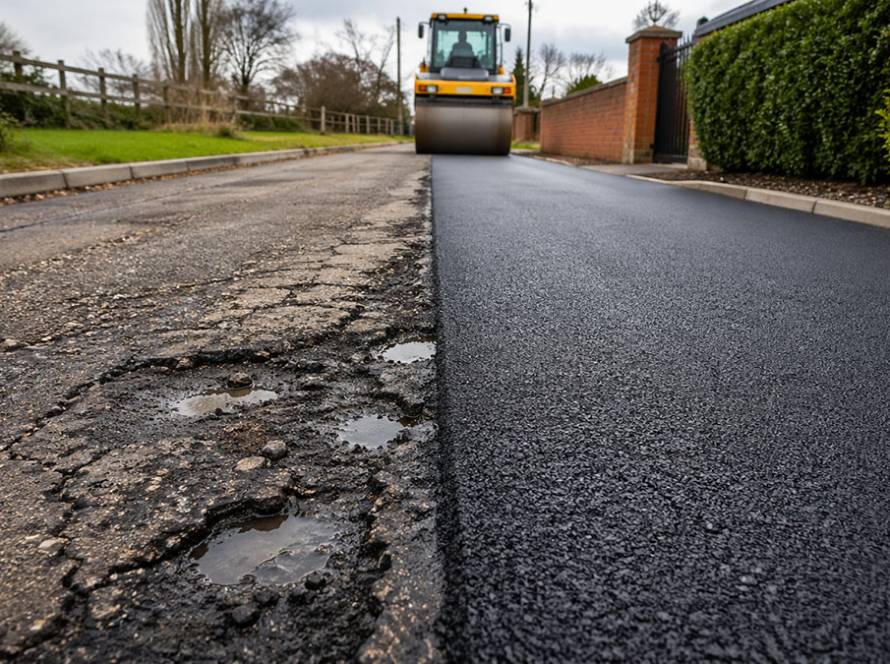
Confined road surfacing environments are common across the UK, particularly within urban developments, older industrial estates, service yards, private access routes, and residential complexes. These locations often present limited access widths, restricted turning circles, overhead obstructions, nearby buildings, or continuous pedestrian and vehicle movement. Unlike open roadway projects, confined surfacing requires a more controlled and adaptable approach to ensure a durable, compliant, and safe finished surface.
Confined road surfacing UK projects are not defined solely by narrow widths. They also include sites where standard machinery cannot operate efficiently, where working hours are restricted, or where surface installation must be completed in carefully managed phases. Property owners and site managers often underestimate the complexity of these projects, yet poor planning in restricted areas frequently leads to premature surface failure or operational disruption.
Common Challenges in Restricted Surfacing Projects
Limited Access for Equipment
One of the primary challenges in confined road surfacing is restricted access for plant and machinery. Standard pavers, rollers, and delivery vehicles may not physically fit within the working area, or they may be unable to manoeuvre safely. This limitation directly affects material delivery, laying consistency, and compaction quality if not managed correctly.
Specialist surfacing contractors assess access constraints early in the planning stage, determining whether smaller machinery, sectional installation, or alternative laying techniques are required. In some cases, materials must be barrowed or transferred manually to maintain consistent placement without damaging surrounding structures.
Proximity to Structures and Services
Confined areas are often bordered by buildings, retaining walls, fencing, kerbs, or underground services. These features restrict excavation depth, limit edge restraint installation, and increase the risk of damage during construction. Poor coordination in these environments can result in compromised edges, inadequate drainage falls, or surface cracking caused by movement against rigid boundaries.
Professional confined road surfacing UK solutions consider service locations, load transfer points, and expansion allowances during design. This ensures that the finished surface performs reliably without exerting damaging pressure on adjacent structures.
Ongoing Site Use and Safety
Many confined surfacing projects take place on live sites such as commercial yards, access roads, or residential developments where full closure is not possible. Managing vehicle movement, pedestrian safety, and emergency access becomes as important as the surfacing itself.
Surfacing works in these conditions often require phased installation, temporary running surfaces, and clear coordination with site management. This level of planning helps maintain operational continuity while ensuring the finished road meets performance expectations.
Planning Considerations for Confined Road Surfacing UK Projects
Site Assessment and Measurement Accuracy
Accurate site surveys are critical when space is limited. Even small measurement errors can create alignment issues, incorrect drainage falls, or insufficient clearances for installation equipment. Confined road surfacing demands precise dimensional planning to ensure that every layer fits within the available footprint without compromising structural integrity.
Surveying also helps identify pinch points, delivery routes, and staging areas, all of which influence how the project is programmed and executed.
Sub-Base and Ground Conditions
Ground preparation plays a defining role in confined road surfacing. Restricted excavation depths are common due to existing surfaces, services, or structural constraints. As a result, sub-base materials and compaction methods must be carefully selected to deliver adequate load-bearing capacity within limited build-up depths.
Failure to address sub-base quality in confined environments often leads to settlement, rutting, and surface cracking. This is why experienced contractors align ground preparation methods with the specific demands of restricted sites rather than applying standard open-road specifications.
Drainage Design in Tight Spaces
Effective drainage is more difficult to achieve in confined areas where natural falls are limited and space for channels or gullies is restricted. Poor drainage design leads to standing water, accelerated surface wear, and increased maintenance costs.
Confined road surfacing UK projects often incorporate subtle crossfalls, discreet drainage channels, or integrated surface water management solutions to ensure water is directed away from the surface without encroaching on usable space.
Material Selection for Restricted Access Roads
Asphalt and Tarmac in Confined Areas
Tarmac and asphalt remain the most practical materials for confined road surfacing due to their flexibility, durability, and adaptability during installation. These materials can be laid in sections, shaped precisely around obstacles, and compacted effectively using smaller rollers where required.
Projects involving tarmac installation in confined areas benefit from controlled laying temperatures and consistent compaction, both of which are essential for achieving a smooth and long-lasting finish in tight spaces.
Hand-Laid vs Machine-Laid Surfacing
In restricted environments, a combination of hand-laying and mechanical installation is often used. While large-scale projects rely on full-width paving machines, confined sites may require smaller pavers or hand-finishing to achieve proper edge definition and surface consistency.
Where access permits, machine lay tarmac can still be used effectively in confined road surfacing UK projects, delivering improved compaction and surface uniformity. The key lies in selecting machinery that matches the site’s spatial limitations rather than forcing unsuitable equipment into restricted areas.
Construction Techniques for Confined Surfacing Works
Sectional Installation and Phasing
Confined road surfacing often involves sectional installation to maintain access and safety. Rather than completing the entire surface in one operation, works are divided into manageable phases that allow parts of the road to remain operational.
This approach reduces disruption and allows each section to be compacted and cured correctly before traffic is introduced. Phased installation is particularly important for commercial sites where downtime directly impacts operations.
Edge Detailing and Restraint Solutions
Edges are inherently vulnerable in confined surfacing environments due to the absence of wide shoulders or verges. Without proper edge support, surfaces can spread, crack, or degrade prematurely.
Professional confined road surfacing UK solutions incorporate robust edge detailing, whether through concrete restraints, kerbing integration, or reinforced transitions. These measures ensure that the surface maintains its shape and load-bearing capacity despite spatial limitations.
Quality Control and Compaction
Achieving correct compaction in confined areas requires careful equipment selection and skilled operatives. Smaller rollers and vibrating plates are often used in combination to ensure uniform density across the surface.
Consistent compaction is essential for preventing early deterioration, especially in areas subject to turning movements, delivery vehicles, or repeated braking. This is where experience in commercial surfacing road surfacing becomes particularly valuable, as confined sites often experience higher stress concentrations than open roads.
Maintenance and Longevity in Restricted Spaces
Confined road surfaces are more susceptible to localised wear due to limited manoeuvring space and concentrated traffic loads. Regular inspection and timely maintenance help extend surface life and reduce long-term costs.
Minor defects such as cracking or surface deformation should be addressed promptly, often through targeted repairs rather than full resurfacing. Professional pothole repairs are particularly effective in confined areas, allowing defects to be resolved without extensive disruption or access requirements.
Long-term performance in confined road surfacing UK projects is closely linked to installation quality. Surfaces that are properly designed, compacted, and detailed during construction require significantly less intervention over their lifespan.
Choosing the Right Contractor for Confined Road Surfacing UK
Confined surfacing projects demand a higher level of technical expertise and planning than standard road installations. Contractors must demonstrate experience with restricted access sites, adaptable machinery, and phased working methods.
Reviewing completed projects through a contractor’s portfolio provides insight into their ability to deliver high-quality results in challenging environments. It also highlights their approach to edge detailing, surface finish, and integration with existing infrastructure.
Engaging a specialist team through comprehensive surfacing services ensures that confined road surfacing is approached strategically rather than reactively. This leads to improved durability, reduced disruption, and a surface that performs reliably despite spatial constraints.
Practical Outcomes for Property Owners and Site Managers
For property owners and commercial site managers, confined road surfacing UK solutions provide safe, durable access without compromising surrounding structures or operations. When executed correctly, these projects improve traffic flow, reduce maintenance liabilities, and enhance overall site functionality.
Understanding the specific challenges of restricted environments allows informed decision-making during planning and contractor selection. With the right approach, confined road surfacing delivers the same level of performance and longevity expected from open-access installations, even in the most space-limited settings.