Edge restraints play a fundamental role in the long-term performance of any surfaced roadway. In UK road surfacing projects, they are often one of the most overlooked components, yet they directly influence how well a surface retains its shape, strength, and structural integrity over time. Without adequate edge restraint, even a well-laid surface can begin to fail prematurely.
At their most basic level, edge restraints provide lateral support to the surfacing layers. They prevent the surface from spreading under traffic loads and protect vulnerable edges from crumbling, cracking, or deforming. This is particularly important for access roads, car parks, service yards, and estate roads where vehicle movements are frequent and often concentrated along defined routes.
In professional road construction, edge restraints are treated as a structural element rather than a finishing detail. Their correct design and installation ensures the surfacing performs as intended throughout its expected lifespan.
Why Road Surfaces Fail at the Edges First
Road surface edges are typically the weakest point in any paved area. Unlike the centre of the carriageway, edges are more exposed to movement, water ingress, and loading stresses. Vehicles frequently mount or track close to edges, especially on narrower access roads or confined commercial sites.
Without a defined restraint, asphalt or tarmac surfaces are free to move laterally. Over time, this movement leads to edge fretting, surface cracking, and eventual breakup. Once an edge begins to fail, water can penetrate beneath the surface layers, weakening the sub-base and accelerating deterioration across the wider area.
This is why professional contractors prioritise edge restraint systems as part of high-quality commercial surfacing and road surfacing projects rather than treating them as an optional extra.
Types of Edge Restraints Used in UK Road Surfacing
Edge restraints come in several forms, each suited to different site conditions and usage requirements. The most common option for permanent road surfacing is concrete edging. This provides a strong, durable boundary that effectively locks the surface in place and resists movement caused by heavy traffic.
Precast concrete kerbs are often used in commercial environments where long-term durability is critical. They provide both structural restraint and a clear visual boundary, which can be beneficial for traffic management and pedestrian safety.
For less formal or rural settings, in-situ concrete edge beams may be installed flush with the surface. These are commonly used on private access roads, farm tracks, and industrial yards where aesthetics are less important than performance.
In some cases, existing hard structures such as walls or drainage channels can act as edge restraints, provided they are structurally sound and correctly integrated into the surfacing design.
How Edge Restraints Improve Structural Performance
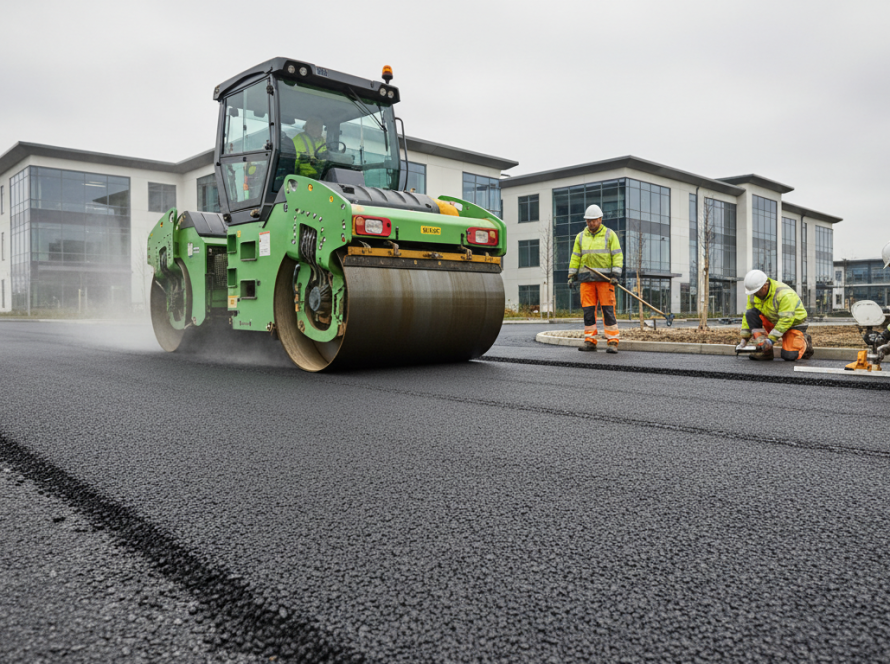
A properly installed edge restraint ensures the surfacing layers remain confined and compacted. During installation, asphalt and tarmac are rolled to achieve density and strength. Without restraint, compaction near the edges is compromised, leading to weaker zones that are prone to failure.
Edge restraints allow full compaction right up to the boundary of the surface. This results in uniform strength across the entire paved area and significantly reduces the risk of early cracking or deformation.
This is particularly important when carrying out tarmac installation for road surfacing services, where consistent compaction and load distribution are essential to long-term durability.
Managing Traffic Loads and Edge Stress
Traffic loading places significant stress on road edges, especially where vehicles turn, brake, or mount kerbs. HGVs, delivery vehicles, and plant machinery can exert lateral forces that quickly damage unsupported edges.
Edge restraints absorb and distribute these forces into the surrounding ground and sub-base rather than allowing them to act directly on the surfacing material. This reduces surface fatigue and prevents edge collapse.
In areas with frequent heavy traffic, such as service yards or construction access routes, edge restraints are essential for maintaining surface integrity. They work in conjunction with appropriate surface thickness and sub-base design to ensure the road performs under load.
Preventing Water Ingress and Sub-Base Failure
Water is one of the primary causes of road surface deterioration in the UK climate. Poorly restrained edges allow water to seep beneath the surface, especially during heavy rainfall or freeze-thaw cycles.
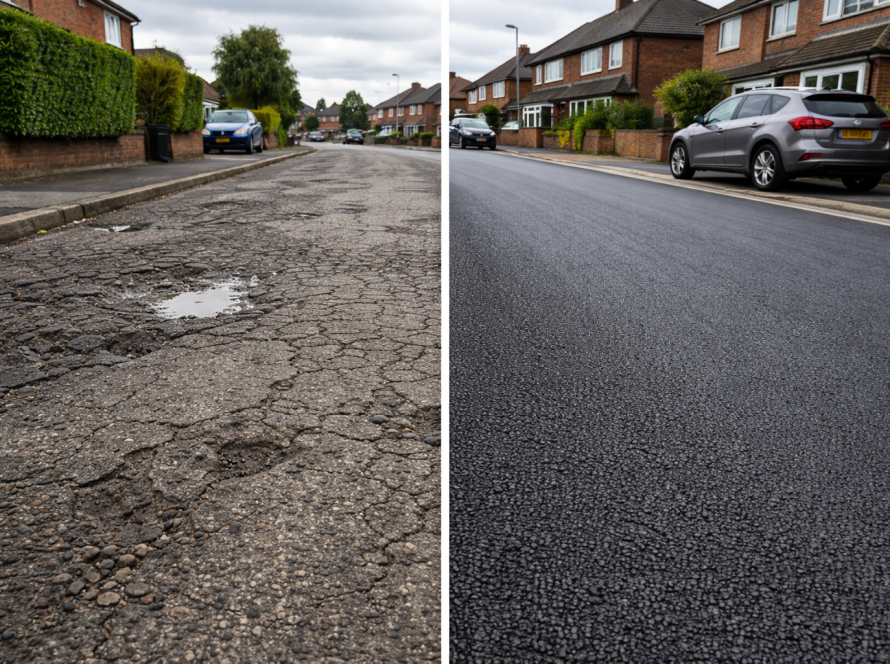
Once water reaches the sub-base, it reduces load-bearing capacity and leads to movement within the structure. This often manifests as surface cracking, rutting, or pothole formation.
Well-designed edge restraints act as a barrier that limits water entry at the surface boundary. When combined with effective drainage design, they help maintain a dry, stable foundation beneath the road. This significantly extends the service life of the surface and reduces the need for reactive maintenance such as pothole repairs.
Edge Restraints in Machine-Laid Surfacing Projects
Machine-laid surfacing relies on precision and consistency. The paving machine lays material to a fixed width and depth, making defined edges essential for accuracy and finish quality.
Edge restraints provide a clear boundary against which machine-laid asphalt can be placed and compacted. This ensures straight, clean edges and prevents material from slumping during installation.
On larger projects using machine lay tarmac, edge restraints also improve efficiency by allowing continuous paving without the need for temporary edge supports or excessive hand finishing.
Retrofitting Edge Restraints to Existing Roads
In some cases, existing road surfaces may lack adequate edge restraint but remain structurally sound overall. Retrofitting edge restraints can be an effective way to extend the life of these surfaces without full reconstruction.
This process typically involves cutting back the edge of the existing surface, installing a concrete restraint, and reinstating the adjacent area. While this requires careful planning, it is often more cost-effective than allowing edge failure to progress and necessitate full resurfacing.
Property owners managing private roads or commercial estates should consider edge restraint upgrades as part of planned maintenance rather than waiting for visible failure to occur.
Long-Term Cost Benefits of Proper Edge Restraints
Although edge restraints add to the initial construction cost, they deliver substantial long-term value. By preventing early surface breakdown, they reduce maintenance frequency, minimise repair costs, and extend resurfacing cycles.
For commercial sites, this also means fewer operational disruptions and improved safety for vehicles and pedestrians. From a whole-life cost perspective, edge restraints are a practical investment rather than an optional enhancement.
When evaluating surfacing proposals, it is important to understand whether edge restraint provision is included and how it will be constructed. This detail often distinguishes a short-term solution from a professionally engineered installation.
Integrating Edge Restraints into Professional Surfacing Design
Effective road surfacing design considers edge restraints from the outset. They must be compatible with the chosen surface material, traffic loading, drainage strategy, and surrounding ground conditions.
Professional contractors assess these factors during site surveys and specification stages. This integrated approach ensures edge restraints support the overall performance of the road rather than being treated as an afterthought.
For property owners and site managers, understanding the importance of edge restraints helps inform better decisions when planning new surfacing works or upgrades to existing roads.