Road surfaces across the UK deteriorate gradually under traffic load, weather exposure, and water ingress. For property owners and site managers, deciding how to address this deterioration is not always straightforward. Two commonly specified approaches are overlay resurfacing and full road resurfacing. While both aim to restore surface performance, they differ significantly in method, cost, longevity, and suitability for different site conditions.
Understanding the difference between these approaches allows informed decisions that balance budget constraints with long-term reliability. Selecting the wrong solution can lead to premature failure, ongoing repairs, and unnecessary disruption.
What Is a Road Resurfacing Overlay?
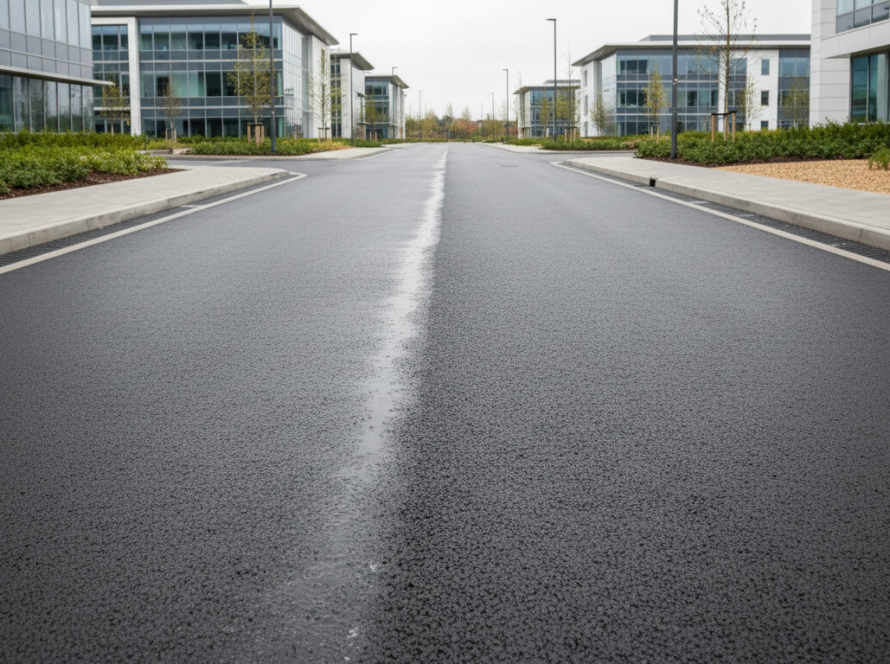
A road resurfacing overlay involves applying a new layer of asphalt or tarmac directly over an existing surface. This approach relies on the underlying structure being fundamentally sound, with no significant sub-base movement or widespread structural cracking.
In the UK, overlay resurfacing is often used on access roads, car parks, and lightly trafficked commercial routes where surface wear is present but the foundation remains intact. The new layer restores surface texture, improves skid resistance, and addresses minor defects such as shallow cracking and surface fretting.
Overlay works are commonly delivered using professional tarmac installation methods to ensure even thickness and proper compaction. When installed correctly, an overlay can significantly extend the life of an existing surface without the cost of full reconstruction.
When Overlay Resurfacing Is Suitable
Overlay resurfacing is appropriate when the existing road shows surface-level deterioration but no evidence of deep structural failure. Typical indicators include surface oxidation, minor cracking that has not propagated through the base layers, and loss of surface texture without deformation.
In these cases, the overlay acts as a protective renewal layer. It seals the existing surface, limits water penetration, and restores visual appearance. For many commercial sites, this provides an effective balance between cost and performance, particularly where traffic volumes are moderate and axle loads are predictable.
Overlay resurfacing is also often chosen where disruption must be kept to a minimum. Shorter installation times mean reduced impact on daily operations, making it suitable for live sites and occupied premises.
Limitations of Overlay Resurfacing
Despite its advantages, overlay resurfacing is not a universal solution. Applying a new surface over a failing structure simply masks underlying problems. If the sub-base is unstable or drainage is inadequate, defects will reflect through the new surface over time.
Cracks caused by movement, subsidence, or water damage tend to reappear even after overlay. This process, known as reflective cracking, reduces the effective lifespan of the new surface and can lead to repeated repair cycles. In such situations, an overlay may appear cost-effective initially but result in higher long-term expenditure.
Professional assessment is therefore essential before specifying an overlay solution, particularly for roads carrying heavy vehicles or subject to frequent turning movements.
What Is Full Road Resurfacing?
Full road resurfacing involves removing the existing surface layers and, where necessary, repairing or replacing the underlying sub-base. This approach addresses both visible surface defects and hidden structural weaknesses, creating a new road construction from the foundation upwards.
In UK commercial and industrial environments, full resurfacing is often specified where long-term durability is critical. This includes logistics yards, industrial estates, and access roads with sustained heavy traffic.
Full resurfacing projects are typically delivered as part of comprehensive commercial surfacing works, allowing drainage improvements, level corrections, and edge detailing to be incorporated into the design.
Situations That Require Full Resurfacing
Full resurfacing is necessary when the existing road shows signs of structural failure rather than surface wear. Common indicators include rutting, widespread cracking patterns, standing water, and uneven settlement.
These symptoms usually point to sub-base issues, inadequate drainage, or insufficient construction depth for current traffic demands. Simply overlaying such surfaces will not resolve the root causes and often leads to rapid deterioration of the new layer.
Where roads have undergone repeated patching or pothole repairs over time, full resurfacing can provide a more effective long-term solution by eliminating weak points and restoring consistent load-bearing capacity.
Cost Differences Between Overlay and Full Resurfacing
Cost is often the primary factor influencing resurfacing decisions. Overlay resurfacing typically involves lower material volumes, reduced labour, and shorter programme durations. This makes it appealing for budget-conscious projects where structural integrity is confirmed.
Full resurfacing requires greater upfront investment due to excavation, waste removal, sub-base reinstatement, and extended construction time. However, this investment often delivers a significantly longer service life and reduced maintenance costs over time.
When assessing value, it is important to consider lifecycle cost rather than initial spend alone. A cheaper overlay that fails prematurely can ultimately cost more than a correctly specified full resurfacing scheme.
Performance and Lifespan Considerations
The expected lifespan of an overlay resurfacing scheme depends heavily on existing conditions and traffic loading. On stable substrates with controlled traffic, overlays can perform well for many years. However, their performance is inherently linked to the quality of the underlying road.
Full resurfacing offers greater predictability in performance. By rebuilding the road structure, designers can specify appropriate layer thicknesses, materials, and drainage solutions to suit site-specific demands. This results in improved resistance to deformation, cracking, and water damage.
For sites where access reliability is critical, such as commercial estates or operational facilities, the enhanced performance of full resurfacing often justifies the higher initial cost.
Impact on Drainage and Levels
Overlay resurfacing raises the finished surface level. While this increase is usually modest, it can affect drainage falls, threshold heights, and adjacent surfaces. Poorly planned overlays may lead to water pooling or reduced clearance at entrances.
Full resurfacing allows levels to be reset and drainage to be redesigned if required. This is particularly beneficial where historical surfacing has compromised falls or where water management is a recurring issue.
Addressing drainage at the resurfacing stage reduces the risk of future surface failure and extends the lifespan of the installation.
Making the Right Choice for Your Site
Choosing between overlay and full road resurfacing should always be based on professional assessment rather than appearance alone. Structural condition, traffic loading, drainage performance, and future usage all play a role in determining the most appropriate solution.
For lightly trafficked access roads with sound foundations, overlay resurfacing can be a practical and cost-effective option. For heavily used or structurally compromised roads, full resurfacing provides greater reliability and long-term value.
Engaging experienced surfacing contractors ensures that resurfacing decisions are supported by thorough site evaluation and technical understanding, reducing the risk of premature failure.
Long-Term Planning and Asset Management
Road surfacing should be viewed as part of a wider asset management strategy rather than a reactive repair task. Planned resurfacing, whether overlay or full reconstruction, allows budgets to be managed more effectively and avoids emergency repairs that disrupt operations.
By understanding the difference between overlay and full road resurfacing, UK property owners and site managers can make informed decisions that align with operational needs and long-term performance expectations.